جميع الكتب

مهني

1 Markets I: The Ecosystem and Exchange-Traded Marketsالأسواق عبر الإنترنت 2 Markets II: Rates, FX and Creditالأسواق عبر الإنترنت 3 Markets III: Commodities, Energy and Cryptoالأسواق عبر الإنترنت 4 Quantitative Methodsالأساليب عبر الإنترنت 5 Derivatives and Volatilityالمشتقات عبر الإنترنت 6 Rates, Credit, XVA and Riskالفائدة والائتمان والمخاطر عبر الإنترنت 7 Research Craft: Predictors, Backtests, Measurement, Portfoliosالبحث عبر الإنترنت 8 Strategies I: Equities and Futuresالاستراتيجيات عبر الإنترنت 9 Strategies II: Volatility, Relative Value, Macro and the Bank Desksالاستراتيجيات عبر الإنترنت 10 Microstructure and Executionالتنفيذ عبر الإنترنت 11 Market Making and High-Frequency Tradingصناعة السوق عبر الإنترنت 12 Machine Learning for Marketsتعلم الآلة عبر الإنترنت 13 Low-Latency Softwareالتكنولوجيا عبر الإنترنت 14 Networks, Hardware and Trading Infrastructureالتكنولوجيا عبر الإنترنت 15 Research, Data and Risk Platformsالتكنولوجيا عبر الإنترنت 16 The Desk and the Firmالشركة عبر الإنترنت 17 The Industry: Firms, Roles and Careersالمسارات المهنية عبر الإنترنت 18 The Interview Bookالمسارات المهنية عبر الإنترنت
التطبيقات حول المدرب تسجيل الدخول ابدأ القراءة

Quantitative Finance · المسرد

ما معنى Compounding in arrears؟

Definition 1.14 Markets II: Rates, FX and Credit · الفصل 1 — Central Banks and the Short Rate

Over an interest period of NN calendar days with business days d1,…,dMd_1, \dots, d_M, fixings r1,…,rMr_1, \dots, r_M and weights nin_i, the calendar days from did_i to the next business day, the rate compounded in arrears is

R  =  [ ∏i=1M(1+ri niB)−1]BN,R \;=\; \Bigl[\,\prod_{i=1}^{M}\Bigl(1 + \frac{r_i\,n_i}{B}\Bigr) - 1\Bigr]\frac{B}{N},

with B=360B = 360 for the dollar and euro and 365 for sterling. It is known only after the last fixing. Three conventions bring the payment date forward: a lookback of pp business days uses rr from pp days before each did_i with the period’s own weights; an observation shift takes rates and weights from a period moved back by pp business days; a lockout freezes the last kk fixings at the one before them.

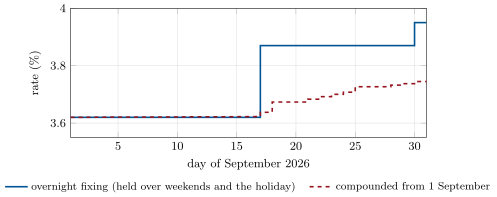
The illustrative fixings of  and the rate compounded from the start of the period to each day. The compounded rate absorbs a change only gradually: each day at the new level is one more weight in an average over all the days so far. Friday fixings weigh three days, the Friday before Labor Day four. The fixings are illustrative, not published SOFR. Data: the chapter’s tutorial.
Figure 1.3. The illustrative fixings of Example 1.16 and the rate compounded from the start of the period to each day. The compounded rate absorbs a change only gradually: each day at the new level is one more weight in an average over all the days so far. Friday fixings weigh three days, the Friday before Labor Day four. The fixings are illustrative, not published SOFR. Data: the chapter’s tutorial.

أمثلة

Example 1.16 (September 2026, illustrated)

Take illustrative fixings of 3.62% up to 16 September, 3.87% from the hike, and 3.95% on the quarter-end day, 30 September (Figure 1.3). Over 1 September to 1 October (30 days, 21 fixings, Labor Day on 7 September) the day-weighted average is 3.7393% and the compounded rate 3.7448%: compounding adds 0.54 basis points, against the 0.56 of Proposition 1.15 for a flat 3.74%. With a five-day lookback the rate is 3.6836%, 6.12 basis points lower, USD 5 098 on USD 100 million: the lookback moves five days of the new rate into the next period, where the borrower will pay them.

اقرأ في الفصل →