
جميع الكتب

مهني

1 Markets I: The Ecosystem and Exchange-Traded Marketsالأسواق عبر الإنترنت 2 Markets II: Rates, FX and Creditالأسواق عبر الإنترنت 3 Markets III: Commodities, Energy and Cryptoالأسواق عبر الإنترنت 4 Quantitative Methodsالأساليب عبر الإنترنت 5 Derivatives and Volatilityالمشتقات عبر الإنترنت 6 Rates, Credit, XVA and Riskالفائدة والائتمان والمخاطر عبر الإنترنت 7 Research Craft: Predictors, Backtests, Measurement, Portfoliosالبحث عبر الإنترنت 8 Strategies I: Equities and Futuresالاستراتيجيات عبر الإنترنت 9 Strategies II: Volatility, Relative Value, Macro and the Bank Desksالاستراتيجيات عبر الإنترنت 10 Microstructure and Executionالتنفيذ عبر الإنترنت 11 Market Making and High-Frequency Tradingصناعة السوق عبر الإنترنت 12 Machine Learning for Marketsتعلم الآلة عبر الإنترنت 13 Low-Latency Softwareالتكنولوجيا عبر الإنترنت 14 Networks, Hardware and Trading Infrastructureالتكنولوجيا عبر الإنترنت 15 Research, Data and Risk Platformsالتكنولوجيا عبر الإنترنت 16 The Desk and the Firmالشركة عبر الإنترنت 17 The Industry: Firms, Roles and Careersالمسارات المهنية عبر الإنترنت 18 The Interview Bookالمسارات المهنية عبر الإنترنت
التطبيقات حول المدرب تسجيل الدخول ابدأ القراءة

Quantitative Finance · المسرد

ما معنى Coordinated omission؟

Definition 5.6 Low-Latency Software · الفصل 5 — Measuring Latency

Coordinated omission is the loss of the slowest measurements when a load generator waits for each response before sending the next request: while the system stalls, the generator sends nothing, so the requests that would have waited during the stall are never issued and never measured.
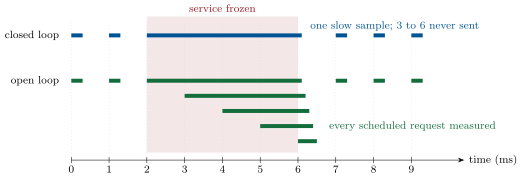
Coordinated omission. Each bar runs from a request’s intended send time to its reply. The closed-loop tester (top) sends at 2, waits through the freeze, and records a single slow sample; the requests due at 3, 4, 5 and 6 are never issued. The open-loop tester (bottom) sends on schedule and measures each request from its intended send time, so every request that waited is counted.
Figure 5.2. Coordinated omission. Each bar runs from a request’s intended send time to its reply. The closed-loop tester (top) sends at 2, waits through the freeze, and records a single slow sample; the requests due at 3, 4, 5 and 6 are never issued. The open-loop tester (bottom) sends on schedule and measures each request from its intended send time, so every request that waited is counted.
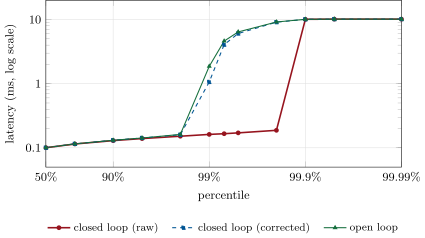
Latency by percentile for a service with a 10\, m s freeze each second, measured by three testers intending one request a millisecond. From the 99th to the 99.8th percentile the closed-loop tester is wrong by a factor of ten to fifty. Data: ll_measure.spectrum, a deterministic simulation of 100 seconds.
Figure 5.3. Latency by percentile for a service with a 10 ms10\,\mathrm{m}\mathrm{s} freeze each second, measured by three testers intending one request a millisecond. From the 99th to the 99.8th percentile the closed-loop tester is wrong by a factor of ten to fifty. Data: ll_measure.spectrum, a deterministic simulation of 100 seconds.

أمثلة

Example 5.7 (One stall a second)

A service answers in about 100 µs100\,\text{µ}\mathrm{s} and freezes for 10 ms10\,\mathrm{m}\mathrm{s} at the start of every second; the testers intend one request a millisecond for 100 seconds (Figure 5.3). The closed-loop tester collects 99 000 samples and reports a p99 of 0.16 ms0.16\,\mathrm{m}\mathrm{s}: the one sample it takes per freeze is 0.1% of the total. Corrected, it reports 1.06 ms1.06\,\mathrm{m}\mathrm{s}; the open-loop tester, which also sees the queue drain after each freeze, 1.87 ms1.87\,\mathrm{m}\mathrm{s}. The service is slow for 1% of the requests that users send, and the naive test says otherwise by an order of magnitude.

اقرأ في الفصل →