সব বই

পেশাদার

1 Markets I: The Ecosystem and Exchange-Traded Marketsবাজার অনলাইন 2 Markets II: Rates, FX and Creditবাজার অনলাইন 3 Markets III: Commodities, Energy and Cryptoবাজার অনলাইন 4 Quantitative Methodsপদ্ধতি অনলাইন 5 Derivatives and Volatilityডেরিভেটিভস অনলাইন 6 Rates, Credit, XVA and Riskসুদহার, ঋণ ও ঝুঁকি অনলাইন 7 Research Craft: Predictors, Backtests, Measurement, Portfoliosগবেষণা অনলাইন 8 Strategies I: Equities and Futuresকৌশল অনলাইন 9 Strategies II: Volatility, Relative Value, Macro and the Bank Desksকৌশল অনলাইন 10 Microstructure and Executionএক্সিকিউশন অনলাইন 11 Market Making and High-Frequency Tradingমার্কেট মেকিং অনলাইন 12 Machine Learning for Marketsমেশিন লার্নিং অনলাইন 13 Low-Latency Softwareপ্রযুক্তি অনলাইন 14 Networks, Hardware and Trading Infrastructureপ্রযুক্তি অনলাইন 15 Research, Data and Risk Platformsপ্রযুক্তি অনলাইন 16 The Desk and the Firmপ্রতিষ্ঠান অনলাইন 17 The Industry: Firms, Roles and Careersক্যারিয়ার অনলাইন 18 Interviews I: Maths, Probability and Speedক্যারিয়ার অনলাইন 19 Interviews II: Markets, Trading Games and the Final Roundক্যারিয়ার অনলাইন 20 Interviews III: Codeক্যারিয়ার অনলাইন
অ্যাপ পরিচিতি Coach সাইন ইন পড়া শুরু করো

বইগুলো এখনো বাংলা ভাষায় পাওয়া যায় না — ইংরেজি সংস্করণ দেখানো হচ্ছে।

Quantitative Finance · পরিভাষা

Corridor and floor systems কী?

অন্য নাম: corridor system · floor system

Definition 1.6 Markets II: Rates, FX and Credit · অধ্যায় 1 — Central Banks and the Short Rate

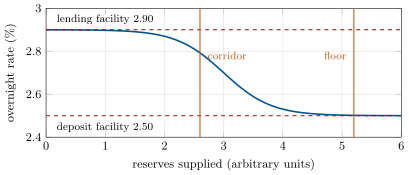
In a corridor system the central bank keeps reserves scarce, so that banks trade them among themselves and the overnight rate settles inside [iD,iL][i_D, i_L], near a target it steers by adjusting the supply of reserves day by day. In a floor system it supplies reserves beyond what banks need, so that the marginal reserve is worth only the deposit rate, and the overnight rate sits at, or just below, iDi_D.

A stylised demand curve for reserves between the ECB’s facility rates of 16 September 2026. With supply at the left vertical line (scarce reserves) the rate is set on the steep part and moves with every change in supply; at the right one (ample reserves) it rests on the deposit rate. The curve’s shape is illustrative; the two facility rates are the ECB’s. Data: the chapter’s simulation.
Figure 1.2. A stylised demand curve for reserves between the ECB’s facility rates of 16 September 2026. With supply at the left vertical line (scarce reserves) the rate is set on the steep part and moves with every change in supply; at the right one (ample reserves) it rests on the deposit rate. The curve’s shape is illustrative; the two facility rates are the ECB’s. Data: the chapter’s simulation.

উদাহরণ

Example 1.7 (The euro corridor)

From 16 September 2026 the ECB’s deposit facility pays 2.50%, its weekly main refinancing operations lend at 2.65% and its marginal lending facility at 2.90%. The corridor is 40 basis points wide. Since 18 September 2024 the refinancing rate sits only 15 basis points above the deposit rate (it had been 50), a change announced in March 2024 so that banks would borrow in the weekly operations as reserves shrink and the overnight rate would stay close to the deposit rate. The euro area has, in effect, chosen a floor while keeping the corridor as its outer bounds.

প্রসঙ্গসহ পড়ো →