सभी किताबें

पेशेवर

ऐप्स परिचय Coach लॉग इन पढ़ना शुरू करें

Quantitative Finance · शब्दावली

COS method क्या है?

Definition 28.3 Quantitative Methods · अध्याय 28 — Transforms, Interpolation and Algorithmic Differentiation

The COS method (Fang and Oosterlee, 2008) truncates the density of y=ln⁡(ST/K)y = \ln(S_T/K) to an interval [a,b][a, b], expands it in a cosine series whose coefficients are read off the characteristic function, Ak≈2b−aRe[φ(kπb−a)e−ikπa/(b−a)]A_k \approx \frac2{b-a}\mathrm{Re}[\varphi(\frac{k\pi}{b-a})e^{-\mathrm ik\pi a/(b-a)}], and integrates the payoff against each cosine in closed form, so that a price is e−rT∑k<N′AkVke^{-rT}\sum_{k<N}{}'A_kV_k (the first term halved).

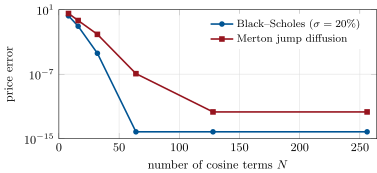
Error of the COS price of a one-year at-the-money call against the number of cosine terms (logarithmic error axis, linear N): exponential convergence down to rounding for Black–Scholes and to the accuracy of the reference series for Merton. Data: the chapter’s tutorial.
Figure 28.1. Error of the COS price of a one-year at-the-money call against the number of cosine terms (logarithmic error axis, linear NN): exponential convergence down to rounding for Black–Scholes and to the accuracy of the reference series for Merton. Data: the chapter’s tutorial.
अध्याय में पढ़ें →