
جميع الكتب

مهني

1 Markets I: The Ecosystem and Exchange-Traded Marketsالأسواق عبر الإنترنت 2 Markets II: Rates, FX and Creditالأسواق عبر الإنترنت 3 Markets III: Commodities, Energy and Cryptoالأسواق عبر الإنترنت 4 Quantitative Methodsالأساليب عبر الإنترنت 5 Derivatives and Volatilityالمشتقات عبر الإنترنت 6 Rates, Credit, XVA and Riskالفائدة والائتمان والمخاطر عبر الإنترنت 7 Research Craft: Predictors, Backtests, Measurement, Portfoliosالبحث عبر الإنترنت 8 Strategies I: Equities and Futuresالاستراتيجيات عبر الإنترنت 9 Strategies II: Volatility, Relative Value, Macro and the Bank Desksالاستراتيجيات عبر الإنترنت 10 Microstructure and Executionالتنفيذ عبر الإنترنت 11 Market Making and High-Frequency Tradingصناعة السوق عبر الإنترنت 12 Machine Learning for Marketsتعلم الآلة عبر الإنترنت 13 Low-Latency Softwareالتكنولوجيا عبر الإنترنت 14 Networks, Hardware and Trading Infrastructureالتكنولوجيا عبر الإنترنت 15 Research, Data and Risk Platformsالتكنولوجيا عبر الإنترنت 16 The Desk and the Firmالشركة عبر الإنترنت 17 The Industry: Firms, Roles and Careersالمسارات المهنية عبر الإنترنت 18 The Interview Bookالمسارات المهنية عبر الإنترنت
التطبيقات حول المدرب تسجيل الدخول ابدأ القراءة

Quantitative Finance · المسرد

ما معنى Credit valuation adjustment؟

Definition 18.1 Rates, Credit, XVA and Risk · الفصل 18 — Credit and Debit Valuation Adjustments

The credit valuation adjustment (CVA) of a netting set is the market value of the loss from the counterparty’s default: the value of the trades without counterparty risk minus their value with it. With the counterparty’s default time τC\tau_C, recovery RCR_C and discounted exposure,

CVA=(1−RC) E[1τC≤T D(0,τC)max⁡(VτC−CτC,0)]≈(1−RC)∑kDEE(tk)(QC(tk−1)−QC(tk)),\begin{align*} \mathrm{CVA} &= (1-R_C)\,\E\bigl[\mathbf 1_{\tau_C\le T}\,D(0,\tau_C)\max(V_{\tau_C}-C_{\tau_C},0)\bigr]\\ &\approx (1-R_C)\sum_k\mathrm{DEE}(t_k)\bigl(Q_C(t_{k-1})-Q_C(t_k)\bigr), \end{align*}

where DEE(t)=E[D(0,t)Et]\mathrm{DEE}(t) = \E[D(0,t)E_t] and the approximation assumes the exposure and the default independent.
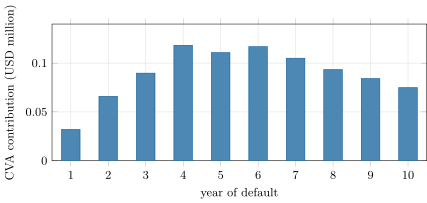
The netting set’s CVA by year of the counterparty’s default: the product of the discounted expected exposure (rising, then flat) and the probability of default in the year (rising with the hazard curve, then discounted by survival). Years four to six contribute most. Data: the chapter’s tutorial.
Figure 18.1. The netting set’s CVA by year of the counterparty’s default: the product of the discounted expected exposure (rising, then flat) and the probability of default in the year (rising with the hazard curve, then discounted by survival). Years four to six contribute most. Data: the chapter’s tutorial.

أمثلة

Example 18.2 (The netting set’s CVA)

The counterparty of chapter 17’s netting set is quoted at 80, 95, 110, 140, 160 and 175 basis points at one to ten years (illustrative BBB), recovery 40%: its ten-year probability of default is 26.4%. With the exposures discounted path by path along the Hull–White scenarios, the netting set’s CVA is USD 891 342. Standalone, the swap’s CVA is 288 250 and the cross-currency swap’s 768 334: netting saves 16%. Over the ten-year default swap’s risky annuity of 7.45, the CVA is 12.0 basis points a year on USD 100 million (Figure 18.1).

اقرأ في الفصل →