Tous les livres

Professionnel

Applis À propos Coach Connexion Commencer la lecture

Quantitative Finance · Glossaire

Qu'est-ce que « Cumulant » ?

Definition 6.9 Quantitative Methods · Chapitre 6 — Jump Processes

The nn-th cumulant κn\kappa_n of a random variable is the nn-th derivative at zero of its cumulant generating function ln⁡E[esX]\ln\E[e^{sX}]; κ1\kappa_1 is the mean, κ2\kappa_2 the variance, κ3/κ23/2\kappa_3/\kappa_2^{3/2} the skewness and κ4/κ22\kappa_4/\kappa_2^2 the excess kurtosis.

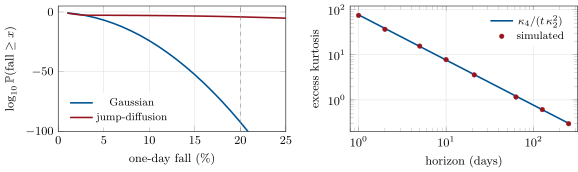
Left: probability that one day’s return falls by at least x, on a _10 scale, for a Gaussian with the market’s daily standard deviation (0.98%) and for the chapter’s jump-diffusion with the same variance; at 20% (dashed) they differ by 88 orders of magnitude. Right: the jump-diffusion’s excess kurtosis over horizons of 1 to 252 days, from its cumulants and from 400 000 simulated returns per horizon. Data: the chapter’s tutorial, seeded.
Figure 6.3. Left: probability that one day’s return falls by at least xx, on a log⁡10\log_{10} scale, for a Gaussian with the market’s daily standard deviation (0.98%) and for the chapter’s jump-diffusion with the same variance; at 20% (dashed) they differ by 88 orders of magnitude. Right: the jump-diffusion’s excess kurtosis over horizons of 1 to 252 days, from its cumulants and from 400 000 simulated returns per horizon. Data: the chapter’s tutorial, seeded.
Lire dans le chapitre →