
সব বই

পেশাদার

1 Markets I: The Ecosystem and Exchange-Traded Marketsবাজার অনলাইন 2 Markets II: Rates, FX and Creditবাজার অনলাইন 3 Markets III: Commodities, Energy and Cryptoবাজার অনলাইন 4 Quantitative Methodsপদ্ধতি অনলাইন 5 Derivatives and Volatilityডেরিভেটিভস অনলাইন 6 Rates, Credit, XVA and Riskসুদহার, ঋণ ও ঝুঁকি অনলাইন 7 Research Craft: Predictors, Backtests, Measurement, Portfoliosগবেষণা অনলাইন 8 Strategies I: Equities and Futuresকৌশল অনলাইন 9 Strategies II: Volatility, Relative Value, Macro and the Bank Desksকৌশল অনলাইন 10 Microstructure and Executionএক্সিকিউশন অনলাইন 11 Market Making and High-Frequency Tradingমার্কেট মেকিং অনলাইন 12 Machine Learning for Marketsমেশিন লার্নিং অনলাইন 13 Low-Latency Softwareপ্রযুক্তি অনলাইন 14 Networks, Hardware and Trading Infrastructureপ্রযুক্তি অনলাইন 15 Research, Data and Risk Platformsপ্রযুক্তি অনলাইন 16 The Desk and the Firmপ্রতিষ্ঠান অনলাইন 17 The Industry: Firms, Roles and Careersক্যারিয়ার অনলাইন 18 Interviews I: Maths, Probability and Speedক্যারিয়ার অনলাইন 19 Interviews II: Markets, Trading Games and the Final Roundক্যারিয়ার অনলাইন 20 Interviews III: Codeক্যারিয়ার অনলাইন
অ্যাপ পরিচিতি Coach সাইন ইন পড়া শুরু করো

বইগুলো এখনো বাংলা ভাষায় পাওয়া যায় না — ইংরেজি সংস্করণ দেখানো হচ্ছে।

Quantitative Finance · পরিভাষা

Decrement index কী?

Definition 19.11 Derivatives and Volatility · অধ্যায় 19 — The Structured-Products Business

A decrement index is built on a total-return index by deducting a fixed amount, a percentage a year or a number of points, in place of the dividends actually paid: its forward depends on that fixed deduction, not on uncertain dividend forecasts.
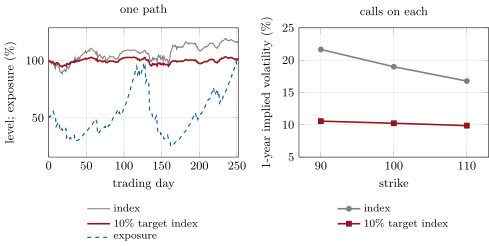
A 10% volatility-target index on the Heston index of chapter 10. Left: one path of the index, the target index and the exposure, which falls as realised volatility rises. Right: implied volatilities of one-year calls on each: the target index’s are close to 10% at every strike. Data: the tutorial.
Figure 19.3. A 10% volatility-target index on the Heston index of chapter 10. Left: one path of the index, the target index and the exposure, which falls as realised volatility rises. Right: implied volatilities of one-year calls on each: the target index’s are close to 10% at every strike. Data: the tutorial.
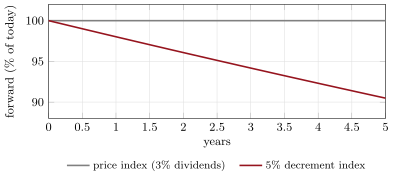
Forwards of a price index paying 3% dividends and of a 5% decrement index on the same total-return index, with a 3% rate. The decrement fixes the forward, and the index drifts down against the market by the excess of the decrement over the dividends. Data: the chapter’s code.
Figure 19.4. Forwards of a price index paying 3% dividends and of a 5% decrement index on the same total-return index, with a 3% rate. The decrement fixes the forward, and the index drifts down against the market by the excess of the decrement over the dividends. Data: the chapter’s code.

উদাহরণ

Example 19.12 (Options on a 10% volatility-target index)

On chapter 10’s Heston model, fitted to chapter 9’s surface, build a 10% volatility-target index with exponentially weighted volatility estimates and leverage capped at 1.5, with zero rates. Over one year the raw index realises 19.8% on average, with a standard deviation of 8.2 points across paths. The target index realises 10.1%, with a standard deviation of 0.6 point. A one-year at-the-money call costs 7.54 on the raw index and 4.07 on the target index, and the implied volatilities are 19.0% and 10.2%. The raw index’s skew, from 21.6% at 90 to 16.8% at 110, nearly vanishes on the target index, 10.6% to 9.9% (Figure 19.3).

Example 19.13 (A decrement index against dividends)

Take a 3% rate. A price index paying 3% dividends has a five-year forward of 100. A 5% decrement index built on the same total-return index has a forward of 90.5, since it loses 2% a year relative to it (Figure 19.4). A five-year at-the-money put at 20% volatility costs 15.2 per 100 on the price index and 19.0 on the decrement index, 24% more. That is what an investor who sells the put inside an autocallable receives in exchange for bearing the gap between the decrement and the dividends actually paid.

প্রসঙ্গসহ পড়ো →