Derivatives and Volatility · Derivatives
19The Structured-Products Business
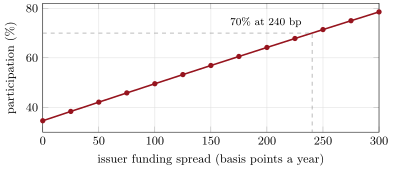
A private-bank client buys a two-year note on an index. It returns all of his capital at maturity, plus 70% of the index’s rise. The option that pays the 70% is an ordinary at-the-money call, and at the index’s volatility and the current rate it costs about 12.5 per 100. What decided whether 70 was possible was not that option. It was the price at which the bank that issued the note borrows. A note is a bond of its issuer, and an issuer that borrows at a high spread over the risk-free rate discounts the guaranteed 100 more steeply, which leaves more of the client’s money to buy options. With no spread the note could have offered 35%. At a spread of 2.4% a year it can offer 70%. The client was paid for lending to the bank, and may not have known it. This chapter takes the business apart: its products and wrappers, the decomposition that prices every note, distribution and its margins and rules, the issuer’s funding, and the systematic indices that products are increasingly written on.
19.1 Products and wrappers
Definition 19.1 (Structured product)
A structured product is an investment whose payoff is a pre-defined function of one or more underlyings, built by combining a fixed-income instrument with derivatives and sold as a single package.
Definition 19.2 (Structured note)
A structured note is a structured product issued as a debt security of a bank or its issuing vehicle: the investor holds the issuer’s credit risk as well as the payoff’s market risk.
The same payoff can be sold in several wrappers. A note is the most common. A certificate or warrant listed on an exchange is still a debt obligation of its issuer. The payoff can also sit in a fund, with collateral held separately, or in a deposit, often with guarantees on part of the capital. It can be written as an over-the-counter swap for institutions, whose counterparty risk is collateralised. It can even be packaged as an exchange-traded fund (One Quant Book 1, chapter 14) or a total return swap (Book 1, chapter 6) on a strategy index. The wrapper decides who bears the issuer’s credit risk, how the product is taxed and regulated, and whether a secondary market exists. The payoff is decomposed the same way in all of them.
The two archetypes are the capital-protected note and the yield enhancer.
Definition 19.3 (Capital-protected note)
A capital-protected note repays at least a stated share of its notional at maturity, such as 90% or 100%, whatever the underlying does, plus a share of the underlying’s rise; the protection is only as good as the issuer’s credit.
Definition 19.4 (Reverse convertible)
A reverse convertible pays a coupon above the issuer’s funding rate and repays par at maturity unless the underlying has fallen below a strike, in which case it repays the underlying’s value (or shares): the investor has sold a put.
Definition 19.5 (Participation rate)
The participation rate of a note is the share of the underlying’s performance it pays above the protected amount, in .
Between the archetypes sit the autocallables of chapter 18, which trade capital protection for coupons, and a long tail of variations. There are caps and floors on the participation, averaging of the final level (chapter 16), worst-ofs on baskets (chapter 17), and knock-in barriers (chapter 15). Every variation is a change to the option leg, and each has a price that the decomposition makes visible.
19.2 Anatomy of a note: a bond plus options
Every note is priced by the same identity. The issue price, 100, equals the issuer’s zero-coupon bond for the guaranteed amounts, plus the options, plus the margin:
with the protected share, the risk-free rate, the issuer’s funding spread (Book 1, chapter 17), the price of the option leg per unit of participation, and the structuring margin. Given any three of , , and the option’s terms, the identity yields the fourth.
Definition 19.6 (Structuring margin)
The structuring margin is the difference between a note’s issue price and the value of its components at the issuer’s own funding curve and the desk’s option prices: the revenue shared between the issuer and the distributors.
Example 19.7 (Seventy percent participation)
A two-year note, 100% protected, on an index with a 3% rate and a 1.5% dividend yield, at chapter 9’s two-year at-the-money volatility of 20.5%. The at-the-money call costs 12.49 per 100, and the margin is 1.5. At a zero funding spread the bond costs 94.18, leaving 4.32 for options: a participation of 34.6%. Each half point of spread adds about 7.5 points of participation. At 1% it is 49.6%, at 2% it is 64.2%, and at 2.40% the bond costs 89.76 and the participation reaches 70% (Figure 19.1).
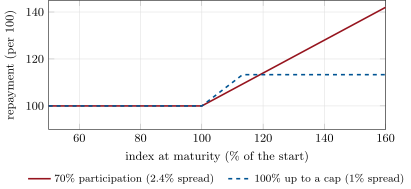
The spread is paid by the investor. A higher spread means a weaker issuer, whose default would take the protection with it. The 70% is compensation for that risk, and a note from a stronger issuer offering 50% is not worse value. The same identity prices the other shapes. With a 1% spread the budget buys 100% participation up to a cap of 113.3%, a two-year return capped at 13.3%, instead of 49.6% uncapped (Figure 19.2). With no spread, the cap falls to 108.7%. The reverse convertible reverses the flow: the investor sells a put, and the premium is added to the coupon.
Example 19.8 (A one-year reverse convertible)
Strike 90%, one year, the issuer’s spread 1%, the same market. The investor sells puts struck at 90%, worth 4.26, and the issuer’s funding benefit is worth 3.92. After a 1.5 margin the note pays a coupon of 6.96%, against a risk-free rate of 3%. If the index ends below 90%, the investor receives instead of par, and the coupon.
19.3 Distribution, margins and regulation
A note passes through several hands before it reaches its buyer. The structurer designs it, and the trading desk prices and hedges it. The issuer, often a separate legal entity, provides the balance sheet. The distributor, a private bank, a retail bank or an independent adviser, sells it. The margin in the identity above is shared among them. The desk keeps a reserve for hedging costs, and the issuer and the distributor are paid through the note’s price.
Regulators focus on what the retail buyer can see. The European Union’s regulation on packaged retail investment products requires a short standardised key information document for every such product. The United States self-regulator FINRA has issued guidance on products with “novel, complicated or intricate derivative-like features”, structured notes among them.
As of September 2026 — Disclosure rules for retail structured products
European Union. Regulation (EU) No 1286/2014 on packaged retail and insurance-based investment products (PRIIPs) requires the manufacturer, before a product is made available to retail investors, to draw up a key information document and publish it on its website. The document is pre-contractual information, must be accurate, fair, clear and not misleading, stands alone, separate from marketing material, and runs to at most three sides of A4 paper. United States. FINRA Regulatory Notice 12-03 (January 2012), “Heightened Supervision of Complex Products”, asks broker-dealers to apply heightened supervision to products such as structured notes, and follows earlier notices on structured products, principal-protected notes and reverse convertibles. Both texts have been amended or supplemented since; check the current versions.
For a quant the regulatory text matters in three places. The disclosure’s performance scenarios and cost figures are computed from models, and the model must be the one the desk uses. The margin must be defensible as fair value. And the product’s value after issue, the price at which the issuer buys notes back, must follow from the same pricing as the issue price, less a bid-offer that the investor was told about.
19.4 Issuer funding and the product lifecycle
A structured note is funding for its issuer. The bank receives 100 today and owes the payoff later. If it hedges the payoff with derivatives, what remains is a loan at its own funding spread. That makes notes one of a bank’s funding sources, and it explains why issuers compete on the rate at which they value their own notes. An issuer that marks its own bond at a high spread can offer better terms. The note is still fairly priced if the spread is its real cost of funding.
After issue, the note lives on the desk’s books like any derivative. The desk runs the Greeks of the option leg and funds or unfunds the bond leg with treasury, and it quotes a secondary price, often as the issuer’s buy-back. That price moves with the market and with the issuer’s spread: a widening of the spread lowers the value of every note outstanding, and an issuer that carries its notes at fair value shows a gain on its own debt. Early redemptions, autocalls (chapter 18) and knock-ins change the funding the issuer holds, which the treasury has to plan for.
19.5 Systematic-strategy indices and options on them
Notes can also pay on a rules-based index rather than on a plain market index. Two such constructions are engineered to make options cheaper.
Definition 19.9 (Systematic strategy index)
A systematic strategy index is an index whose level follows a published rule for trading one or more underlyings, rebalanced mechanically, and on which notes and options are written.
Definition 19.10 (Volatility-target index)
A volatility-target index holds an exposure to an underlying equal to a target volatility divided by a recent estimate of the underlying’s volatility, capped at a maximum leverage, with the rest in cash; its realised volatility stays close to the target whatever the underlying does.
Definition 19.11 (Decrement index)
A decrement index is built on a total-return index by deducting a fixed amount, a percentage a year or a number of points, in place of the dividends actually paid: its forward depends on that fixed deduction, not on uncertain dividend forecasts.
The volatility target makes the index’s volatility nearly deterministic. An option on it is almost a Black–Scholes option at the target, cheap when the target is below the market’s volatility. The issuer’s hedge then carries almost no volatility risk, and its vega position no longer depends on the index’s implied volatility. The decrement index removes dividend risk (chapter 5). The issuer knows the forward exactly and can sell long-dated puts on it without holding dividend exposure. When the decrement exceeds the expected dividends, the index drifts down relative to the market, and puts on it are dearer.
Example 19.12 (Options on a 10% volatility-target index)
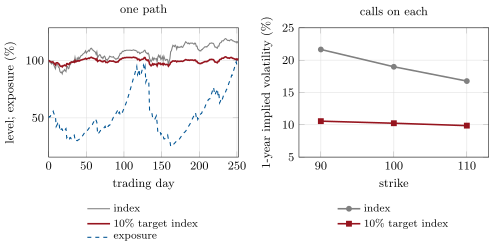
On chapter 10’s Heston model, fitted to chapter 9’s surface, build a 10% volatility-target index with exponentially weighted volatility estimates and leverage capped at 1.5, with zero rates. Over one year the raw index realises 19.8% on average, with a standard deviation of 8.2 points across paths. The target index realises 10.1%, with a standard deviation of 0.6 point. A one-year at-the-money call costs 7.54 on the raw index and 4.07 on the target index, and the implied volatilities are 19.0% and 10.2%. The raw index’s skew, from 21.6% at 90 to 16.8% at 110, nearly vanishes on the target index, 10.6% to 9.9% (Figure 19.3).
Example 19.13 (A decrement index against dividends)
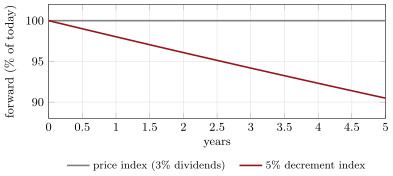
Take a 3% rate. A price index paying 3% dividends has a five-year forward of 100. A 5% decrement index built on the same total-return index has a forward of 90.5, since it loses 2% a year relative to it (Figure 19.4). A five-year at-the-money put at 20% volatility costs 15.2 per 100 on the price index and 19.0 on the decrement index, 24% more. That is what an investor who sells the put inside an autocallable receives in exchange for bearing the gap between the decrement and the dividends actually paid.
Both constructions move a risk from the issuer to the investor. The target index gives the investor the timing risk of its rebalancing, which buys after rallies and sells after falls, a short-gamma pattern. The decrement gives the investor the gap between the decrement and the dividends. The payoff looks the same as on the plain index, and it is not. A structurer’s first question about a strategy index is therefore what it has taken out of the option price, and who now holds it.
19.6 Tutorial: decomposing a note
Goal. Decompose a protected note into a bond at the issuer’s rate and an option leg; solve for the participation, the cap, the reverse convertible’s coupon and the funding spread that a target requires; build a volatility-target and a decrement index and price options on them. End state: the four figures and the numbers of the weekend problem.
The budget identity, both ways:
def max_participation(t: float, r: float, spread: float, q: float, vol_of_k, margin: float,
                      protection: float = 1.0, cap: float | None = None) -> float:
    """The participation that leaves the issuer exactly its margin: the option budget is the issue price (100) less
    the protected amount's zero-coupon value less the margin, divided by the price of one unit of the option leg."""
    budget = 100.0 - protection * zero_coupon(t, r, spread) - margin
    unit = value(protected_note(t, 1.0, 0.0, cap), r, spread, q, vol_of_k)
    return budget / unit


def spread_for_participation(target: float, t: float, r: float, q: float, vol_of_k, margin: float,
                             protection: float = 1.0, cap: float | None = None) -> float:
    """The issuer funding spread at which the note can offer `target` participation after `margin` (closed form:
    the zero-coupon value must equal 100 - margin - target x option)."""
    unit = value(protected_note(t, 1.0, 0.0, cap), r, 0.0, q, vol_of_k)
    zc = (100.0 - margin - target * unit) / protection
    return -math.log(zc / 100.0) / t - r
Listing 19.1. Participation from the spread, and the spread from a participation. code/firm/termsheet/firm_termsheet.py The volatility-target index, with a lagged volatility estimate so the rule uses only past data:
def ewma_vol(returns: np.ndarray, lam: float = 0.94, dt: float = 1 / 252, start: float = 0.2) -> np.ndarray:
    """Exponentially weighted volatility estimate known at the start of each day (lagged), per path.
    returns has shape (n_paths, n_days)."""
    var = np.full(returns.shape[0], start * start)
    out = np.empty_like(returns)
    for i in range(returns.shape[1]):
        out[:, i] = np.sqrt(var)
        var = lam * var + (1 - lam) * returns[:, i] ** 2 / dt
    return out


def vol_target_index(returns: np.ndarray, target: float, rate: float = 0.0, lam: float = 0.94, max_lev: float = 1.5,
                     dt: float = 1 / 252, fee: float = 0.0) -> np.ndarray:
    """Index levels (start 1) of a strategy holding target / sigma_hat of the underlying (capped at max_lev) and the
    rest in cash at `rate`, less a running fee. returns are the underlying's simple daily excess-of-nothing returns."""
    exposure = np.minimum(target / ewma_vol(returns, lam, dt), max_lev)
    daily = exposure * returns + (1 - exposure) * rate * dt - fee * dt
    return np.hstack([np.ones((returns.shape[0], 1)), np.cumprod(1 + daily, axis=1)])
Listing 19.2. Volatility estimate and target index. code/firm/termsheet/firm_termsheet.py - Run
dv_structured.named_result(),capped_note(),reverse_convertible(),vol_target_options(),decrement_example()andfig_structured.py.
What to change next. Lower the protection to 95% and find the participation at a 1% spread; replace the at-the-money call by the average-price call of chapter 16; give the target index a 0.5% annual fee and compare the call price.
19.7 Build: the term-sheet decomposer
Purpose. The miniature firm’s term-sheet engine for its structured-products desk: notes as bond and option legs, the solvers that turn a client’s request into terms, and the strategy-index calculators.
Interface. Leg(kind, quantity, strike), Note(maturity, legs); zero_coupon(t, r, spread); value(note, r, spread, q, vol_of_k); protected_note(t, participation, protection, cap); max_participation(…, margin, protection, cap); spread_for_participation(target, …); reverse_convertible_coupon; ewma_vol, vol_target_index(returns, target, rate, lam, max_lev, dt, fee); decrement_index(total_return, decrement, dt, points, base).
Rules. The bond leg is always discounted at the issuer’s funding curve; options at the desk’s smile; the margin is an explicit input, never a residual left in the option price; strategy indices use only information available at each rebalancing.
Acceptance tests. code/firm/termsheet/tests/: the budget identity holds and inverts; a weaker issuer offers more participation; a cap buys more participation; the reverse convertible’s coupon rises with the spread and the volatility; a target index on constant volatility realises its target; a decrement index on a deterministic total-return index has the expected forward, in percentage and in points.
Stretch. Notes on the autocallable pricer of chapter 18; secondary-market pricing with the issuer’s current spread; the key information document’s performance scenarios.
Sources and further reading
- Regulation (EU) No 1286/2014 of the European Parliament and of the Council of 26 November 2014 on key information documents for packaged retail and insurance-based investment products (PRIIPs), Official Journal of the European Union L 352/1.
- FINRA, Regulatory Notice 12-03, “Heightened Supervision of Complex Products” (January 2012).
19.8 Exercises
Exercise 19.1 ★
Write a two-year 100%-protected note with 60% participation as a bond plus options. Which legs does the investor hold?
Solution
Solution of Exercise 19.1.
A two-year zero-coupon bond of the issuer paying 100, and 0.6 at-the-money calls on 100 of the index expiring in two years. The investor holds both: long the issuer’s bond (and so its credit risk) and long the calls.
Exercise 19.2 ★
With a 3% rate, what is the two-year zero-coupon bond worth at spreads of 0 and 2.4%? How much option budget does the spread add?
Solution
Solution of Exercise 19.2.
at a zero spread and at 2.4%: the spread adds 4.41 of option budget, more than doubling the 4.32 left at a zero spread after the margin.
Exercise 19.3 ★
Why is a note that offers 70% participation not necessarily better value than one offering 50%?
Solution
Solution of Exercise 19.3.
The higher participation may be paid for by a weaker issuer’s higher funding spread, which is the investor’s compensation for a higher risk of losing the protection in a default; or by a larger margin taken elsewhere. Compare notes at the same issuer credit, or add the value of the credit risk to the comparison.
Exercise 19.4 ★★
Using the chapter’s numbers (call 12.49, margin 1.5), what participation does a 95%-protected note offer at a zero spread?
Solution
Solution of Exercise 19.4.
The budget is , so the participation is : five points of protection buy more than twice the participation.
Exercise 19.5 ★★
Explain why options on a volatility-target index are cheap, and what the investor gives up.
Solution
Solution of Exercise 19.5.
The index’s volatility is held near the target by construction, so the option is priced near the target volatility, well below the underlying’s, and its vega is small. The investor gives up exposure when volatility is high (after falls, typically) and takes the rule’s rebalancing, which sells after falls and buys after rallies; returns in trending markets differ from the plain index’s.
Exercise 19.6 ★★
A 5% decrement index is built on a total-return index whose underlying pays 3% dividends. By how much does it lag the price index each year, and who bears the difference if dividends are cut to 1%?
Solution
Solution of Exercise 19.6.
It lags by the excess of the decrement over the dividends, 2% a year. If dividends fall to 1%, the price index gains relative to the total-return index while the decrement index does not change its rule: the lag widens to 4% a year, borne by the investor in the decrement index; the issuer, hedged on the fixed decrement, is unaffected.
Exercise 19.7 ★★★
Coding. Price the reverse convertible of Example 19.8 with strikes of 80%, 90% and 100% and report the coupons.
Solution
Solution of Exercise 19.7.
At a 1% spread and a 1.5 margin: 5.17% with the strike at 80%, 6.96% at 90% and 9.71% at 100%. The funding benefit is the same, 3.92; the puts sold are worth 2.55, 4.26 and 6.91 per 100.
Exercise 19.8 ★★★
Find the flaw. “Our notes offer the best participation on the market, so our option pricing must be the most competitive.”
Solution
Solution of Exercise 19.8.
The participation depends at least as much on the issuer’s funding spread (and on the margin) as on option prices: a weak issuer with the same option prices offers more participation. The claim confuses credit with pricing.
19.9 Problem: Seventy Percent Participation
Problem 19.1
Weekend problem — what pays for the participation
A distributor asks for a two-year, 100%-protected note on an index with 70% participation. Rate 3%, dividend yield 1.5%, chapter 9’s surface, a structuring margin of 1.5.
Part I — The option leg.
- Give the two-year at-the-money volatility and the call price per 100.
- What does 70% participation cost?
- Why is the call priced at the smile’s at-the-money volatility and not at another strike’s?
- What would averaging the final level over the last six months do to the call’s price?
- What would a cap do?
Part II — The bond leg.
- Give the zero-coupon bond’s value at a zero spread.
- Give the participation available at spreads of 0, 1% and 2%.
- At what spread is 70% possible? What does the bond cost there?
- Why does the issuer’s spread enter the note’s price?
- What does the investor bear in exchange for the higher participation?
Part III — Alternatives.
- At a 1% spread, what cap allows 100% participation?
- What does the same budget buy as a one-year reverse convertible struck at 90%?
- What participation would a 10% volatility-target index allow, using the one-year implied volatility ratio as a guide?
- Why might the distributor prefer a strategy index, and why might the investor not?
- How does the key information document constrain the presentation?
Part IV — Judgement.
- Is 70% at 240 basis points a good deal for the client?
- What would you tell the distributor about an issuer that offers 70% when others offer 50%?
- How does a widening of the issuer’s spread after issue affect the note’s secondary price?
- State the named result: the issuer funding spread at which a two-year 100%-protected note can offer 70% participation after a 1.5% margin.
- In one sentence: what does a capital-protected note’s participation measure?
Solution
Solution of Problem 19.1.
1. 20.5%; 12.49 per 100. 2. . 3. The call is struck at the initial level, at the money; its price uses the smile’s volatility at that strike and expiry. 4. Lower it, roughly as the volatility of the averaged level is lower (chapter 16), raising the participation. 5. Sell back the upside above the cap, lowering the option’s price and raising the participation below the cap. 6. 94.18. 7. 34.6%, 49.6% and 64.2%. 8. 2.40% a year (240 basis points); the bond then costs 89.76. 9. The note is the issuer’s debt: the guaranteed 100 is a promise of the issuer, valued at the rate the issuer pays to borrow. 10. The issuer’s credit risk: in a default the protection, and the options’ value, are lost with the bond. 11. 113.3%: 100% participation up to a 13.3% gain. 12. A coupon of 6.96% a year, with the capital exposed below 90%. 13. About 62% at a zero spread: at-the-money calls at the 10% target volatility cost about 6.94 per 100 over two years. 14. It makes the note look generous (high participation) and removes the issuer’s volatility and dividend risk; the investor takes the index’s rule, and returns that can differ widely from the plain index’s. 15. In the European Union: a key information document of at most three sides of A4, stand-alone, accurate, fair, clear and not misleading, with standardised scenarios and costs. 16. It is fair if 240 basis points is the issuer’s real credit spread and the client wants that credit risk; it is not a gift. 17. That the difference is the issuer’s credit, and that the note should be compared with the issuer’s bonds. 18. It lowers it: the bond leg is revalued at the wider spread, even if the index has not moved. 19. 2.40% a year (240 basis points): the zero-coupon bond then costs 89.76, leaving 8.74 for 70% of the 12.49 call after the 1.5 margin. 20. How much option the issuer’s funding and the margin leave the investor, per unit of the underlying’s rise.
19.10 Interview questions
Interview question 19.1 ★ trader, bank
Price a capital-protected note. What determines the participation rate?
Solution
Solution of Interview question 19.1.
: the protected amount as the issuer’s zero-coupon bond, the participation times the option leg’s price, and the margin. The participation rises with rates, with the issuer’s spread and with lower protection, and falls with volatility, dividends (through the call) and the margin.
What the interviewer is looking for: the identity and each input’s direction.
Interview question 19.2 ★ bank
Why is a structured note a funding instrument for the issuing bank?
Solution
Solution of Interview question 19.2.
The bank receives the issue price now and owes the payoff later; hedging the payoff with derivatives leaves a loan at the bank’s own funding spread. Notes diversify the bank’s funding sources and are priced off its funding curve.
What the interviewer is looking for: the note as debt, and the hedged residual.
Interview question 19.3 ★★ trader
What is a reverse convertible, and what is the investor short?
Solution
Solution of Interview question 19.3.
A note paying an enhanced coupon and repaying the underlying’s value, rather than par, if it ends below a strike: the investor is short a put (and long the issuer’s bond). The coupon is the funding rate plus the put premium, less the margin.
What the interviewer is looking for: the short put and where the coupon comes from.
Interview question 19.4 ★★ researcher
Why are options on volatility-target indices cheaper than options on their underlying? What risk remains for the issuer?
Solution
Solution of Interview question 19.4.
The index’s volatility is managed to the target, so options on it are priced near the target and have little vega. What remains for the issuer is the gap between the rule’s estimated and realised volatility (sudden jumps before the exposure adjusts) and the index’s rebalancing costs; the issuer also bears model risk on the index’s path-dependence.
What the interviewer is looking for: the managed volatility and the residual risks.
Interview question 19.5 ★★ risk
The issuer’s credit spread widens by 100 basis points. What happens to its outstanding notes and to its accounts?
Solution
Solution of Interview question 19.5.
The bond leg of every outstanding note is worth less (discounted at the wider spread), so secondary prices fall; an issuer that carries its notes at fair value shows a gain on its own debt. New issues can offer better terms. Funding plans change if buy-backs rise.
What the interviewer is looking for: secondary prices, own-credit accounting and new issuance.
Interview question 19.6 ★★★ trader, bank
A distributor wants the highest possible coupon on a one-year note. Walk through the choices that raise it and what each costs the investor.
Solution
Solution of Interview question 19.6.
Sell more optionality: a put closer to the money (5.2%, 7.0%, 9.7% for strikes of 80%, 90%, 100% in the chapter), a daily barrier, a worst-of on several names (correlation), an autocall that shortens the note; use a weaker issuer (credit); cut the margin. Each raises the coupon by selling the investor more risk; explain each in those terms.
What the interviewer is looking for: the levers and the risk each transfers.