 Coach
CoachDeep hedging represents the hedging strategy by a neural network that maps what is observable at each date (time, prices, current holdings) to the new holdings, and trains it on simulated paths to minimise a convex risk measure of the hedged P&L after all frictions (Buehler, Gonon, Teichmann and Wood, 2019).
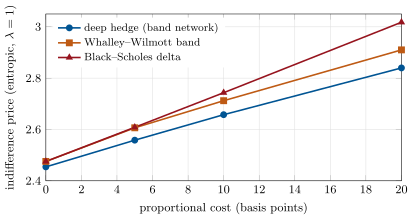
ml_hedge.hedging.| policy | entropic risk | expected shortfall 95% | mean cost | standard deviation |
|---|---|---|---|---|
| deep hedge, entropic | 2.658 | 3.817 | 2.442 | 0.643 |
| deep hedge, expected shortfall | 2.671 | 3.763 | 2.457 | 0.657 |
| Whalley–Wilmott band | 2.712 | 4.044 | 2.424 | 0.703 |
| Black–Scholes delta | 2.743 | 4.090 | 2.507 | 0.595 |
| no hedge | 8.767 | 9.992 | 2.235 | 2.945 |
ml_hedge.hedging, shortfall_hedge.