
সব বই

পেশাদার

1 Markets I: The Ecosystem and Exchange-Traded Marketsবাজার অনলাইন 2 Markets II: Rates, FX and Creditবাজার অনলাইন 3 Markets III: Commodities, Energy and Cryptoবাজার অনলাইন 4 Quantitative Methodsপদ্ধতি অনলাইন 5 Derivatives and Volatilityডেরিভেটিভস অনলাইন 6 Rates, Credit, XVA and Riskসুদহার, ঋণ ও ঝুঁকি অনলাইন 7 Research Craft: Predictors, Backtests, Measurement, Portfoliosগবেষণা অনলাইন 8 Strategies I: Equities and Futuresকৌশল অনলাইন 9 Strategies II: Volatility, Relative Value, Macro and the Bank Desksকৌশল অনলাইন 10 Microstructure and Executionএক্সিকিউশন অনলাইন 11 Market Making and High-Frequency Tradingমার্কেট মেকিং অনলাইন 12 Machine Learning for Marketsমেশিন লার্নিং অনলাইন 13 Low-Latency Softwareপ্রযুক্তি অনলাইন 14 Networks, Hardware and Trading Infrastructureপ্রযুক্তি অনলাইন 15 Research, Data and Risk Platformsপ্রযুক্তি অনলাইন 16 The Desk and the Firmপ্রতিষ্ঠান অনলাইন 17 The Industry: Firms, Roles and Careersক্যারিয়ার অনলাইন 18 Interviews I: Maths, Probability and Speedক্যারিয়ার অনলাইন 19 Interviews II: Markets, Trading Games and the Final Roundক্যারিয়ার অনলাইন 20 Interviews III: Codeক্যারিয়ার অনলাইন
অ্যাপ পরিচিতি Coach সাইন ইন পড়া শুরু করো

বইগুলো এখনো বাংলা ভাষায় পাওয়া যায় না — ইংরেজি সংস্করণ দেখানো হচ্ছে।

Quantitative Finance · পরিভাষা

Dense price ladder কী?

Definition 19.2 Low-Latency Software · অধ্যায় 19 — The Order Book Builder

A dense price ladder keeps the price levels of a book in an array indexed by the distance in ticks from a base price, one slot per tick whether or not a level exists there, covering a window around the touch; levels outside the window live in a sparse structure, and the window is moved (recentred) when the touch approaches its edge.
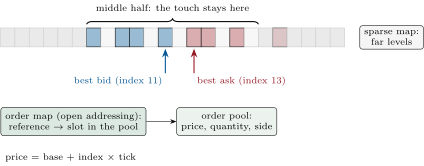
The build’s book. Levels live in a dense array indexed by ticks from a base price (blue: bids, red: asks, grey: empty); the best bid and ask are indices kept up to date. When a best price leaves the middle half of the array, the base is moved to centre the touch and the orders are filed again. Orders are found through an open-addressing map from their reference to a slot in a fixed pool.
Figure 19.1. The build’s book. Levels live in a dense array indexed by ticks from a base price (blue: bids, red: asks, grey: empty); the best bid and ask are indices kept up to date. When a best price leaves the middle half of the array, the base is moved to centre the touch and the orders are filed again. Orders are found through an open-addressing map from their reference to a slot in a fixed pool.
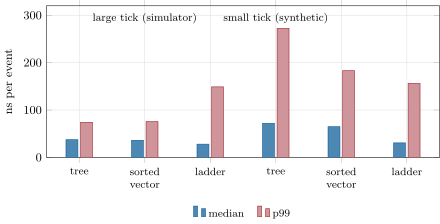
Time to apply one event with three book structures, on the simulator’s minute of chapter 18 (a large-tick instrument, about 190 000 events) and on 100 000 synthetic small-tick events (orders up to 300 ticks from the mid). The timer’s own cost is subtracted. Measured on a laptop (Intel Core Ultra 7 155H) under WSL2, no isolated cores. Data: bench_books.py.
Figure 19.2. Time to apply one event with three book structures, on the simulator’s minute of chapter 18 (a large-tick instrument, about 190 000 events) and on 100 000 synthetic small-tick events (orders up to 300 ticks from the mid). The timer’s own cost is subtracted. Measured on a laptop (Intel Core Ultra 7 155H) under WSL2, no isolated cores. Data: bench_books.py.
প্রসঙ্গসহ পড়ো →