
सभी किताबें

पेशेवर

1 Markets I: The Ecosystem and Exchange-Traded Marketsबाज़ार ऑनलाइन 2 Markets II: Rates, FX and Creditबाज़ार ऑनलाइन 3 Markets III: Commodities, Energy and Cryptoबाज़ार ऑनलाइन 4 Quantitative Methodsविधियाँ ऑनलाइन 5 Derivatives and Volatilityडेरिवेटिव्स ऑनलाइन 6 Rates, Credit, XVA and Riskब्याज दरें, क्रेडिट और जोखिम ऑनलाइन 7 Research Craft: Predictors, Backtests, Measurement, Portfoliosअनुसंधान ऑनलाइन 8 Strategies I: Equities and Futuresरणनीतियाँ ऑनलाइन 9 Strategies II: Volatility, Relative Value, Macro and the Bank Desksरणनीतियाँ ऑनलाइन 10 Microstructure and Executionनिष्पादन ऑनलाइन 11 Market Making and High-Frequency Tradingमार्केट मेकिंग ऑनलाइन 12 Machine Learning for Marketsमशीन लर्निंग ऑनलाइन 13 Low-Latency Softwareतकनीक ऑनलाइन 14 Networks, Hardware and Trading Infrastructureतकनीक ऑनलाइन 15 Research, Data and Risk Platformsतकनीक ऑनलाइन 16 The Desk and the Firmफ़र्म ऑनलाइन 17 The Industry: Firms, Roles and Careersकरियर ऑनलाइन 18 Interviews I: Maths, Probability and Speedकरियर ऑनलाइन 19 Interviews II: Markets, Trading Games and the Final Roundकरियर ऑनलाइन 20 Interviews III: Codeकरियर ऑनलाइन
ऐप्स परिचय Coach लॉग इन पढ़ना शुरू करें

Quantitative Finance · शब्दावली

Dense price ladder क्या है?

Definition 19.2 Low-Latency Software · अध्याय 19 — The Order Book Builder

A dense price ladder keeps the price levels of a book in an array indexed by the distance in ticks from a base price, one slot per tick whether or not a level exists there, covering a window around the touch; levels outside the window live in a sparse structure, and the window is moved (recentred) when the touch approaches its edge.
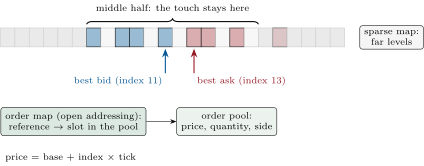
The build’s book. Levels live in a dense array indexed by ticks from a base price (blue: bids, red: asks, grey: empty); the best bid and ask are indices kept up to date. When a best price leaves the middle half of the array, the base is moved to centre the touch and the orders are filed again. Orders are found through an open-addressing map from their reference to a slot in a fixed pool.
Figure 19.1. The build’s book. Levels live in a dense array indexed by ticks from a base price (blue: bids, red: asks, grey: empty); the best bid and ask are indices kept up to date. When a best price leaves the middle half of the array, the base is moved to centre the touch and the orders are filed again. Orders are found through an open-addressing map from their reference to a slot in a fixed pool.
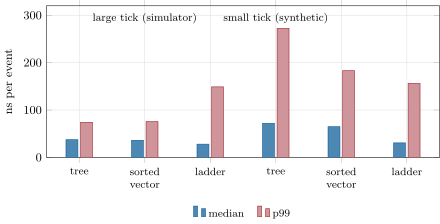
Time to apply one event with three book structures, on the simulator’s minute of chapter 18 (a large-tick instrument, about 190 000 events) and on 100 000 synthetic small-tick events (orders up to 300 ticks from the mid). The timer’s own cost is subtracted. Measured on a laptop (Intel Core Ultra 7 155H) under WSL2, no isolated cores. Data: bench_books.py.
Figure 19.2. Time to apply one event with three book structures, on the simulator’s minute of chapter 18 (a large-tick instrument, about 190 000 events) and on 100 000 synthetic small-tick events (orders up to 300 ticks from the mid). The timer’s own cost is subtracted. Measured on a laptop (Intel Core Ultra 7 155H) under WSL2, no isolated cores. Data: bench_books.py.
अध्याय में पढ़ें →