
All books

Professional

Apps About Coach Log in Start reading

Quantitative Finance · Glossary

What is Difference-in-differences?

Definition 6.5 Microstructure and Execution · Chapter 6 — Tick Size, Queues and Priority

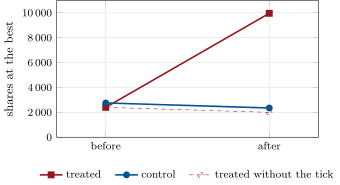
A difference-in-differences estimate of a treatment’s effect compares the change in an outcome for treated units between before and after with the change for untreated (control) units over the same dates: (yˉT,1−yˉT,0)−(yˉC,1−yˉC,0)(\bar y_{T,1}-\bar y_{T,0})-(\bar y_{C,1}-\bar y_{C,0}). It removes what changed for everyone, under the assumption that treated and control outcomes would have moved in parallel without the treatment; in a regression it is the coefficient on the interaction of the treated and after indicators.
A simulated tick-size experiment: depth at the best for eight treated and eight control stocks before and after the treated stocks move to a five-cent grid, while every stock sees more volatility and noise flow. The dashed line is the parallel-trend counterfactual; the gap to it at the end is the difference-in-differences estimate. Data: mx_ticks.did_panel.
Figure 6.3. A simulated tick-size experiment: depth at the best for eight treated and eight control stocks before and after the treated stocks move to a five-cent grid, while every stock sees more volatility and noise flow. The dashed line is the parallel-trend counterfactual; the gap to it at the end is the difference-in-differences estimate. Data: mx_ticks.did_panel.
Read in context →