
সব বই

পেশাদার

1 Markets I: The Ecosystem and Exchange-Traded Marketsবাজার অনলাইন 2 Markets II: Rates, FX and Creditবাজার অনলাইন 3 Markets III: Commodities, Energy and Cryptoবাজার অনলাইন 4 Quantitative Methodsপদ্ধতি অনলাইন 5 Derivatives and Volatilityডেরিভেটিভস অনলাইন 6 Rates, Credit, XVA and Riskসুদহার, ঋণ ও ঝুঁকি অনলাইন 7 Research Craft: Predictors, Backtests, Measurement, Portfoliosগবেষণা অনলাইন 8 Strategies I: Equities and Futuresকৌশল অনলাইন 9 Strategies II: Volatility, Relative Value, Macro and the Bank Desksকৌশল অনলাইন 10 Microstructure and Executionএক্সিকিউশন অনলাইন 11 Market Making and High-Frequency Tradingমার্কেট মেকিং অনলাইন 12 Machine Learning for Marketsমেশিন লার্নিং অনলাইন 13 Low-Latency Softwareপ্রযুক্তি অনলাইন 14 Networks, Hardware and Trading Infrastructureপ্রযুক্তি অনলাইন 15 Research, Data and Risk Platformsপ্রযুক্তি অনলাইন 16 The Desk and the Firmপ্রতিষ্ঠান অনলাইন 17 The Industry: Firms, Roles and Careersক্যারিয়ার অনলাইন 18 Interviews I: Maths, Probability and Speedক্যারিয়ার অনলাইন 19 Interviews II: Markets, Trading Games and the Final Roundক্যারিয়ার অনলাইন 20 Interviews III: Codeক্যারিয়ার অনলাইন
অ্যাপ পরিচিতি Coach সাইন ইন পড়া শুরু করো

বইগুলো এখনো বাংলা ভাষায় পাওয়া যায় না — ইংরেজি সংস্করণ দেখানো হচ্ছে।

Quantitative Finance · পরিভাষা

Direct market access and sponsored access কী?

অন্য নাম: direct market access · sponsored access

Definition 4.8 Markets I: The Ecosystem and Exchange-Traded Markets · অধ্যায় 4 — Exchanges, Brokers and Venues

Under direct market access (DMA) a client sends orders through the broker’s systems, which check them and pass them to the exchange under the broker’s membership. Under sponsored access the client connects to the exchange directly, with its own lines and machines, using the broker’s membership identifier; the broker’s risk checks are applied to that flow without its passing through the broker’s order-handling infrastructure.
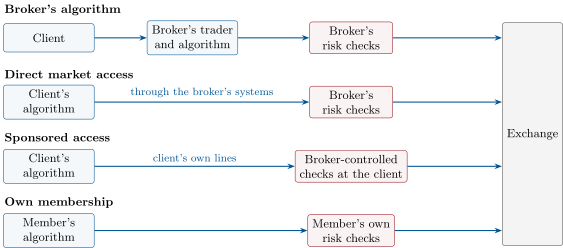
Four ways to reach the same matching engine, from slowest and cheapest to set up (top) to fastest and most demanding (bottom). In every row a regulated firm’s pre-trade checks (red) sit between the algorithm and the exchange: what changes is whose they are and where they run.
Figure 4.2. Four ways to reach the same matching engine, from slowest and cheapest to set up (top) to fastest and most demanding (bottom). In every row a regulated firm’s pre-trade checks (red) sit between the algorithm and the exchange: what changes is whose they are and where they run.
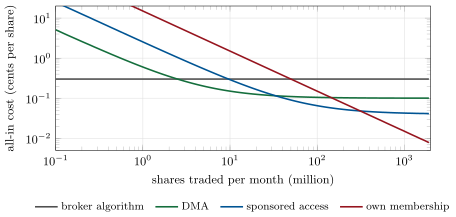
Cost per share of four access models against monthly volume (both axes logarithmic). The cheapest model changes three times over four decades of volume. Data: the illustrative charges of , computed by the chapter’s script.
Figure 4.3. Cost per share of four access models against monthly volume (both axes logarithmic). The cheapest model changes three times over four decades of volume. Data: the illustrative charges of Example 4.11, computed by the chapter’s script.

উদাহরণ

Example 4.11 (Four models, three crossovers)

Take illustrative charges of 0.30 cent a share with no fixed cost for a broker’s algorithm; 0.10 cent plus $5 000 a month for DMA; 0.04 cent plus $25 000 a month for sponsored access (the client now pays for its own lines and colocation); and $150 000 a month with no per-share charge for a firm’s own membership (compliance, capital, memberships). The crossovers are 5 000/0.002=2.55\,000/0.002 = 2.5 million shares a month, 20 000/0.0006=3320\,000/0.0006 = 33 million, and 125 000/0.0004=313125\,000/0.0004 = 313 million. A firm trading 15 million shares a day is past the last one; a fund trading one million a month should not even consider DMA (Figure 4.3).

প্রসঙ্গসহ পড়ো →