
جميع الكتب

مهني

1 Markets I: The Ecosystem and Exchange-Traded Marketsالأسواق عبر الإنترنت 2 Markets II: Rates, FX and Creditالأسواق عبر الإنترنت 3 Markets III: Commodities, Energy and Cryptoالأسواق عبر الإنترنت 4 Quantitative Methodsالأساليب عبر الإنترنت 5 Derivatives and Volatilityالمشتقات عبر الإنترنت 6 Rates, Credit, XVA and Riskالفائدة والائتمان والمخاطر عبر الإنترنت 7 Research Craft: Predictors, Backtests, Measurement, Portfoliosالبحث عبر الإنترنت 8 Strategies I: Equities and Futuresالاستراتيجيات عبر الإنترنت 9 Strategies II: Volatility, Relative Value, Macro and the Bank Desksالاستراتيجيات عبر الإنترنت 10 Microstructure and Executionالتنفيذ عبر الإنترنت 11 Market Making and High-Frequency Tradingصناعة السوق عبر الإنترنت 12 Machine Learning for Marketsتعلم الآلة عبر الإنترنت 13 Low-Latency Softwareالتكنولوجيا عبر الإنترنت 14 Networks, Hardware and Trading Infrastructureالتكنولوجيا عبر الإنترنت 15 Research, Data and Risk Platformsالتكنولوجيا عبر الإنترنت 16 The Desk and the Firmالشركة عبر الإنترنت 17 The Industry: Firms, Roles and Careersالمسارات المهنية عبر الإنترنت 18 The Interview Bookالمسارات المهنية عبر الإنترنت
التطبيقات حول المدرب تسجيل الدخول ابدأ القراءة

Quantitative Finance · المسرد

ما معنى Distance to default؟

Definition 14.4 Rates, Credit, XVA and Risk · الفصل 14 — Structural Credit Models

The distance to default of a firm over a horizon TT is the number of standard deviations by which the expected log asset value exceeds the default point:

DD=ln⁡(V0/D)+(μ−12σV2)TσVT,\mathrm{DD} = \frac{\ln(V_0/D)+(\mu-\tfrac12\sigma_V^2)T}{\sigma_V\sqrt T},

with μ\mu the real-world asset drift. In the Merton model the real-world probability of default is N(−DD)N(-\mathrm{DD}); in practice the distance is mapped to default frequencies through a history of defaults, because asset returns are not normal.
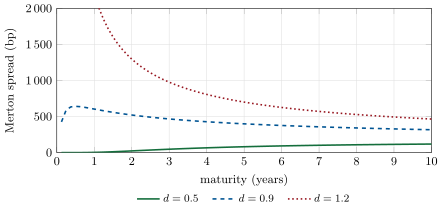
Merton yield spreads against maturity at three quasi-leverages d = De-rT/V_0, asset volatility 25%: rising for a safe firm, humped near the default point, falling for a firm whose assets are worth less than its discounted debt. Data: the chapter’s tutorial.
Figure 14.2. Merton yield spreads against maturity at three quasi-leverages d=De−rT/V0d = De^{-rT}/V_0, asset volatility 25%: rising for a safe firm, humped near the default point, falling for a firm whose assets are worth less than its discounted debt. Data: the chapter’s tutorial.

أمثلة

Example 14.5 (Two probabilities)

With an asset drift of 8%, the firm’s five-year distance to default is 1.02 and the real-world probability of default 15.4%, against the risk-neutral 32.7% of Example 14.3. The gap is the default risk premium of chapter 13 in structural form: under the risk-neutral measure the assets drift at rr instead of μ\mu.

اقرأ في الفصل →