
सभी किताबें

पेशेवर

1 Markets I: The Ecosystem and Exchange-Traded Marketsबाज़ार ऑनलाइन 2 Markets II: Rates, FX and Creditबाज़ार ऑनलाइन 3 Markets III: Commodities, Energy and Cryptoबाज़ार ऑनलाइन 4 Quantitative Methodsविधियाँ ऑनलाइन 5 Derivatives and Volatilityडेरिवेटिव्स ऑनलाइन 6 Rates, Credit, XVA and Riskब्याज दरें, क्रेडिट और जोखिम ऑनलाइन 7 Research Craft: Predictors, Backtests, Measurement, Portfoliosअनुसंधान ऑनलाइन 8 Strategies I: Equities and Futuresरणनीतियाँ ऑनलाइन 9 Strategies II: Volatility, Relative Value, Macro and the Bank Desksरणनीतियाँ ऑनलाइन 10 Microstructure and Executionनिष्पादन ऑनलाइन 11 Market Making and High-Frequency Tradingमार्केट मेकिंग ऑनलाइन 12 Machine Learning for Marketsमशीन लर्निंग ऑनलाइन 13 Low-Latency Softwareतकनीक ऑनलाइन 14 Networks, Hardware and Trading Infrastructureतकनीक ऑनलाइन 15 Research, Data and Risk Platformsतकनीक ऑनलाइन 16 The Desk and the Firmफ़र्म ऑनलाइन 17 The Industry: Firms, Roles and Careersकरियर ऑनलाइन 18 Interviews I: Maths, Probability and Speedकरियर ऑनलाइन 19 Interviews II: Markets, Trading Games and the Final Roundकरियर ऑनलाइन 20 Interviews III: Codeकरियर ऑनलाइन
ऐप्स परिचय Coach लॉग इन पढ़ना शुरू करें

Quantitative Finance · शब्दावली

Dividend play क्या है?

Definition 26.5 Derivatives and Volatility · अध्याय 26 — Options Market Making in Practice

A dividend play is a trade on the eve of an ex-dividend date in which market makers buy and sell large, offsetting quantities of a deep in-the-money call among themselves and exercise all their long calls; because assignment falls pro rata on all short positions, their short calls absorb most of the non-assignment left by holders who fail to exercise, and each unassigned short call earns the dividend less the time value.
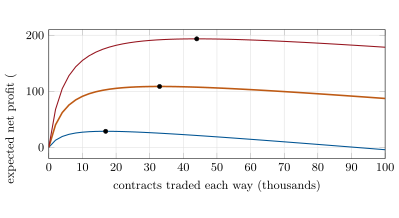
Expected net profit of a dividend play on one call series (10 000 public contracts, $48 gain per unassigned call, $0.50 of fees per contract traded each way) against the size of the trade, for three shares of holders failing to exercise; dots mark the best size. Data: the tutorial.
Figure 26.3. Expected net profit of a dividend play on one call series (10 000 public contracts, $48 gain per unassigned call, $0.50 of fees per contract traded each way) against the size of the trade, for three shares of holders failing to exercise; dots mark the best size. Data: the tutorial.

उदाहरण

Example 26.6 (One call series)

A dividend of 50 cents ($50 a contract), a put worth 2 cents ($2), so a gain of $48 per unassigned contract; 10 000 public contracts; fees (an assumption) of $0.10 a contract per trade and $0.05 per exercise, so $0.50 per qq for four trades and two exercises. If 30% of holders fail to exercise, the best trade is 32 947 contracts. It leaves 2 605 short calls unassigned, 87% of the 3 000 that were not exercised, for a gross gain of $125 026, fees of $16 474 and a net of $108 553. With 10% failing the best trade is 16 909 contracts and nets $28 591; with 50%, 43 990 contracts and $193 510 (Figure 26.3).

अध्याय में पढ़ें →