 Pelatih
A dividend play is a trade on the eve of an ex-dividend date in which market makers buy and sell large, offsetting quantities of a deep in-the-money call among themselves and exercise all their long calls; because assignment falls pro rata on all short positions, their short calls absorb most of the non-assignment left by holders who fail to exercise, and each unassigned short call earns the dividend less the time value.
Contoh
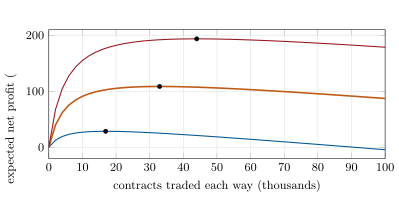
Example 26.6 (One call series)
A dividend of 50 cents ($50 a contract), a put worth 2 cents ($2), so a gain of $48 per unassigned contract; 10 000 public contracts; fees (an assumption) of $0.10 a contract per trade and $0.05 per exercise, so $0.50 per for four trades and two exercises. If 30% of holders fail to exercise, the best trade is 32 947 contracts. It leaves 2 605 short calls unassigned, 87% of the 3 000 that were not exercised, for a gross gain of $125 026, fees of $16 474 and a net of $108 553. With 10% failing the best trade is 16 909 contracts and nets $28 591; with 50%, 43 990 contracts and $193 510 (Figure 26.3).