جميع الكتب

مهني

1 Markets I: The Ecosystem and Exchange-Traded Marketsالأسواق عبر الإنترنت 2 Markets II: Rates, FX and Creditالأسواق عبر الإنترنت 3 Markets III: Commodities, Energy and Cryptoالأسواق عبر الإنترنت 4 Quantitative Methodsالأساليب عبر الإنترنت 5 Derivatives and Volatilityالمشتقات عبر الإنترنت 6 Rates, Credit, XVA and Riskالفائدة والائتمان والمخاطر عبر الإنترنت 7 Research Craft: Predictors, Backtests, Measurement, Portfoliosالبحث عبر الإنترنت 8 Strategies I: Equities and Futuresالاستراتيجيات عبر الإنترنت 9 Strategies II: Volatility, Relative Value, Macro and the Bank Desksالاستراتيجيات عبر الإنترنت 10 Microstructure and Executionالتنفيذ عبر الإنترنت 11 Market Making and High-Frequency Tradingصناعة السوق عبر الإنترنت 12 Machine Learning for Marketsتعلم الآلة عبر الإنترنت 13 Low-Latency Softwareالتكنولوجيا عبر الإنترنت 14 Networks, Hardware and Trading Infrastructureالتكنولوجيا عبر الإنترنت 15 Research, Data and Risk Platformsالتكنولوجيا عبر الإنترنت 16 The Desk and the Firmالشركة عبر الإنترنت 17 The Industry: Firms, Roles and Careersالمسارات المهنية عبر الإنترنت 18 The Interview Bookالمسارات المهنية عبر الإنترنت
التطبيقات حول المدرب تسجيل الدخول ابدأ القراءة

Quantitative Finance · المسرد

ما معنى Drift detector, Page–Hinkley test, adaptive windowing؟

يُعرف أيضًا باسم: drift detector · Page--Hinkley test · adaptive windowing

Definition 12.4 Machine Learning for Markets · الفصل 12 — Online Learning and Drift

A drift detector watches a statistic of a model in production (its errors, its gains, a feature’s distribution) and raises an alarm when the statistic’s distribution appears to have changed. The Page–Hinkley test accumulates the deviations of the monitored value below its running mean, less a tolerance δ\delta, and alarms when the sum rises more than hh above its running minimum (Page, 1954; Hinkley, 1971). Adaptive windowing (ADWIN) keeps a window of recent values and drops its older part whenever some split of the window into two sub-windows has means further apart than a Hoeffding-type bound at confidence δ\delta (Bifet and Gavaldà, 2007).

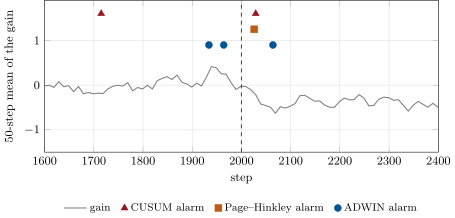
One stream whose coefficients reverse at step 2 000 (dashed): the 50-step mean of the deployed model’s standardised gain, and each detector’s alarms from 300 steps before the reversal to its first alarm after it (markers at arbitrary heights, one row per detector). Data: ml_online.
Figure 12.2. One stream whose coefficients reverse at step 2 000 (dashed): the 50-step mean of the deployed model’s standardised gain, and each detector’s alarms from 300 steps before the reversal to its first alarm after it (markers at arbitrary heights, one row per detector). Data: ml_online.
اقرأ في الفصل →