جميع الكتب

مهني

1 Markets I: The Ecosystem and Exchange-Traded Marketsالأسواق عبر الإنترنت 2 Markets II: Rates, FX and Creditالأسواق عبر الإنترنت 3 Markets III: Commodities, Energy and Cryptoالأسواق عبر الإنترنت 4 Quantitative Methodsالأساليب عبر الإنترنت 5 Derivatives and Volatilityالمشتقات عبر الإنترنت 6 Rates, Credit, XVA and Riskالفائدة والائتمان والمخاطر عبر الإنترنت 7 Research Craft: Predictors, Backtests, Measurement, Portfoliosالبحث عبر الإنترنت 8 Strategies I: Equities and Futuresالاستراتيجيات عبر الإنترنت 9 Strategies II: Volatility, Relative Value, Macro and the Bank Desksالاستراتيجيات عبر الإنترنت 10 Microstructure and Executionالتنفيذ عبر الإنترنت 11 Market Making and High-Frequency Tradingصناعة السوق عبر الإنترنت 12 Machine Learning for Marketsتعلم الآلة عبر الإنترنت 13 Low-Latency Softwareالتكنولوجيا عبر الإنترنت 14 Networks, Hardware and Trading Infrastructureالتكنولوجيا عبر الإنترنت 15 Research, Data and Risk Platformsالتكنولوجيا عبر الإنترنت 16 The Desk and the Firmالشركة عبر الإنترنت 17 The Industry: Firms, Roles and Careersالمسارات المهنية عبر الإنترنت 18 The Interview Bookالمسارات المهنية عبر الإنترنت
التطبيقات حول المدرب تسجيل الدخول ابدأ القراءة

Quantitative Finance · المسرد

ما معنى Duration, DV01, convexity؟

يُعرف أيضًا باسم: Macaulay duration · modified duration · DV01 · convexity

Definition 3.8 Markets II: Rates, FX and Credit · الفصل 3 — Government Bonds

With flows aka_k at times tkt_k (in periods) and v=1/(1+y/f)v = 1/(1 + y/f), the Macaulay duration is the present-value weighted average time of the flows, D=1fP∑ktkakvtkD = \frac{1}{f P}\sum_k t_k a_k v^{t_k}, in years. The modified duration is Dmod=−1PdPdy=D/(1+y/f)D_{\mathrm{mod}} = -\frac1P \frac{dP}{dy} = D/(1 + y/f). The DV01 is the fall in price for a one-basis-point rise in yield, P Dmod×10−4P\,D_{\mathrm{mod}} \times 10^{-4} per 100, usually quoted per million of face. The convexity is C=1Pd2Pdy2\mathcal C = \frac1P \frac{d^2P}{dy^2}.

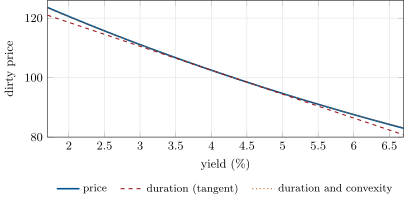
Price against yield for the ten-year note of , two and a half percentage points either side of 4.20%. The tangent (duration) lies below the curve on both sides: a bond gains more when yields fall than it loses when they rise by the same amount, here by 2.2 to 2.6 points at the edges. The second-order approximation stays close to the curve over the whole range. Data: the chapter’s tutorial.
Figure 3.2. Price against yield for the ten-year note of Example 3.10, two and a half percentage points either side of 4.20%. The tangent (duration) lies below the curve on both sides: a bond gains more when yields fall than it loses when they rise by the same amount, here by 2.2 to 2.6 points at the edges. The second-order approximation stays close to the curve over the whole range. Data: the chapter’s tutorial.

أمثلة

Example 3.10 (The ten-year note)

At 4.200% the note of Example 3.4 has a clean price of 100.397405 (100-12+), a dirty price of 100.870911, a Macaulay duration of 8.142 years, a modified duration of 7.975, a DV01 of USD 804 per million and a convexity of 75.8. A 100-basis-point rise costs 7.675 points; duration alone predicts 8.044, duration and convexity together 7.662 (Figure 3.2).

اقرأ في الفصل →