Semua buku

Profesional

Aplikasi Tentang Pelatih Masuk Mulai membaca

Quantitative Finance · Glosarium

Apa itu Duration, DV01, convexity?

Dikenal juga sebagai: Macaulay duration · modified duration · DV01 · convexity

Definition 3.8 Markets II: Rates, FX and Credit · Bab 3 — Government Bonds

With flows aka_k at times tkt_k (in periods) and v=1/(1+y/f)v = 1/(1 + y/f), the Macaulay duration is the present-value weighted average time of the flows, D=1fP∑ktkakvtkD = \frac{1}{f P}\sum_k t_k a_k v^{t_k}, in years. The modified duration is Dmod=−1PdPdy=D/(1+y/f)D_{\mathrm{mod}} = -\frac1P \frac{dP}{dy} = D/(1 + y/f). The DV01 is the fall in price for a one-basis-point rise in yield, P Dmod×10−4P\,D_{\mathrm{mod}} \times 10^{-4} per 100, usually quoted per million of face. The convexity is C=1Pd2Pdy2\mathcal C = \frac1P \frac{d^2P}{dy^2}.

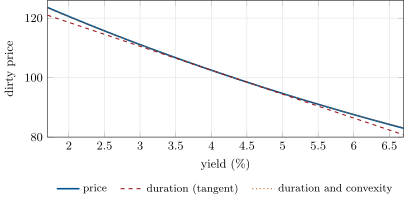
Price against yield for the ten-year note of , two and a half percentage points either side of 4.20%. The tangent (duration) lies below the curve on both sides: a bond gains more when yields fall than it loses when they rise by the same amount, here by 2.2 to 2.6 points at the edges. The second-order approximation stays close to the curve over the whole range. Data: the chapter’s tutorial.
Figure 3.2. Price against yield for the ten-year note of Example 3.10, two and a half percentage points either side of 4.20%. The tangent (duration) lies below the curve on both sides: a bond gains more when yields fall than it loses when they rise by the same amount, here by 2.2 to 2.6 points at the edges. The second-order approximation stays close to the curve over the whole range. Data: the chapter’s tutorial.

Contoh

Example 3.10 (The ten-year note)

At 4.200% the note of Example 3.4 has a clean price of 100.397405 (100-12+), a dirty price of 100.870911, a Macaulay duration of 8.142 years, a modified duration of 7.975, a DV01 of USD 804 per million and a convexity of 75.8. A 100-basis-point rise costs 7.675 points; duration alone predicts 8.044, duration and convexity together 7.662 (Figure 3.2).

Baca dalam konteks →