
全部书籍

专业

应用 关于 Coach 登录 开始阅读

书籍暂未推出简体中文版——当前显示英文版。

Quantitative Finance · 术语表

什么是 Expectation–maximisation algorithm?

又称: expectation--maximisation algorithm

Definition 19.8 Quantitative Methods · 第 19 章 — State-Space Models and the Kalman Filter

The expectation–maximisation algorithm (Dempster, Laird and Rubin, 1977) maximises a likelihood with unobserved variables by alternating an E-step, the expected complete-data log-likelihood given the data and the current parameters, and an M-step that maximises it. For state-space models the E-step is the smoother and the M-step for HH and QQ has a closed form (Shumway and Stoffer, 1982).
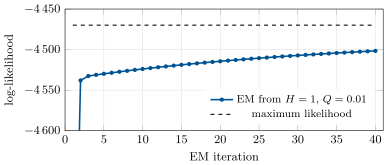
EM on the scaled Brent–WTI hedge model: the log-likelihood rises at every step (from -4\,947 at the start, off the chart) but approaches the maximum found by direct optimisation (dashed, -4\,470) slowly. Data: FRED series DCOILBRENTEU and DCOILWTICO (EIA).
Figure 19.4. EM on the scaled Brent–WTI hedge model: the log-likelihood rises at every step (from −4 947-4\,947 at the start, off the chart) but approaches the maximum found by direct optimisation (dashed, −4 470-4\,470) slowly. Data: FRED series DCOILBRENTEU and DCOILWTICO (EIA).
在原文中阅读 →