جميع الكتب

مهني

1 Markets I: The Ecosystem and Exchange-Traded Marketsالأسواق عبر الإنترنت 2 Markets II: Rates, FX and Creditالأسواق عبر الإنترنت 3 Markets III: Commodities, Energy and Cryptoالأسواق عبر الإنترنت 4 Quantitative Methodsالأساليب عبر الإنترنت 5 Derivatives and Volatilityالمشتقات عبر الإنترنت 6 Rates, Credit, XVA and Riskالفائدة والائتمان والمخاطر عبر الإنترنت 7 Research Craft: Predictors, Backtests, Measurement, Portfoliosالبحث عبر الإنترنت 8 Strategies I: Equities and Futuresالاستراتيجيات عبر الإنترنت 9 Strategies II: Volatility, Relative Value, Macro and the Bank Desksالاستراتيجيات عبر الإنترنت 10 Microstructure and Executionالتنفيذ عبر الإنترنت 11 Market Making and High-Frequency Tradingصناعة السوق عبر الإنترنت 12 Machine Learning for Marketsتعلم الآلة عبر الإنترنت 13 Low-Latency Softwareالتكنولوجيا عبر الإنترنت 14 Networks, Hardware and Trading Infrastructureالتكنولوجيا عبر الإنترنت 15 Research, Data and Risk Platformsالتكنولوجيا عبر الإنترنت 16 The Desk and the Firmالشركة عبر الإنترنت 17 The Industry: Firms, Roles and Careersالمسارات المهنية عبر الإنترنت 18 The Interview Bookالمسارات المهنية عبر الإنترنت
التطبيقات حول المدرب تسجيل الدخول ابدأ القراءة

Quantitative Finance · المسرد

ما معنى Exposure profiles؟

يُعرف أيضًا باسم: expected exposure · expected negative exposure · potential future exposure · expected positive exposure

Definition 17.3 Rates, Credit, XVA and Risk · الفصل 17 — Counterparty Exposure

The expected exposure is EE(t)=E[Et]\mathrm{EE}(t) = \E[E_t]; the expected negative exposure is ENE(t)=E[min⁡(Vt−Ct,0)]\mathrm{ENE}(t) = \E[\min(V_t-C_t,0)], the counterparty’s expected exposure to the bank; the potential future exposure PFEq(t)\mathrm{PFE}_q(t) is the qq-quantile of EtE_t (97.5% here); the expected positive exposure over a horizon HH is the time average EPE=1H∫0HEE(t) dt\mathrm{EPE} = \frac1H\int_0^H\mathrm{EE}(t)\,dt.

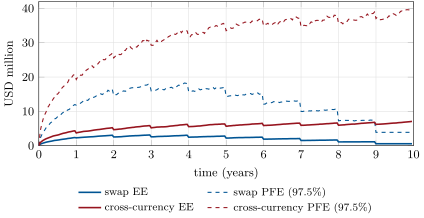
Exposure profiles of a ten-year interest rate swap (humped: uncertainty grows while the remaining cash flows run off) and a ten-year cross-currency swap (rising to maturity: the final exchange of notionals keeps the FX risk to the end). The small teeth are the annual payments. Data: the chapter’s tutorial.
Figure 17.1. Exposure profiles of a ten-year interest rate swap (humped: uncertainty grows while the remaining cash flows run off) and a ten-year cross-currency swap (rising to maturity: the final exchange of notionals keeps the FX risk to the end). The small teeth are the annual payments. Data: the chapter’s tutorial.

أمثلة

Example 17.4 (Two trades with one counterparty)

A bank receives fixed at the par rate of 3.80% on a USD 100 million ten-year swap (chapter 1’s SOFR curve, Hull–White with κ=3%\kappa = 3\% and a normal volatility of 90 basis points), and with the same counterparty receives USD fixed at 3.80% on USD 110 million and pays EUR fixed at the ESTR par rate of 2.59% on EUR 100 million for ten years, exchanging the notionals at the end (EURUSD at 1.10, volatility 8%). On 4 000 paths simulated every ten business days, the swap’s EE peaks at USD 3.13 million after three years and its PFE at USD 18.26 million after 3.9 years: rate risk grows with time and the remaining duration shrinks. The cross-currency swap’s EE rises to USD 7.09 million and its PFE to USD 39.93 million just before maturity, driven by the final exchange (Figure 17.1).

Example 17.12 (A counterparty that weakens with the euro)

Let the counterparty of the cross-currency swap have a hazard rate of 2%×(Xt/FX(0,t))−52\%\times(X_t/F_X(0,t))^{-5}: a 10% fall of the euro below its forward raises its hazard by about 70%. The bank’s exposure is largest when the euro has fallen. Weighting the paths by the probability of default in each period, the expected exposure conditional on default is 2.52 times the unconditional EE at its peak, and 2.22 times on average over the life (Figure 17.5).

اقرأ في الفصل →