 Pelatih
The expected exposure is ; the expected negative exposure is , the counterparty’s expected exposure to the bank; the potential future exposure is the -quantile of (97.5% here); the expected positive exposure over a horizon is the time average .
Contoh
Example 17.4 (Two trades with one counterparty)
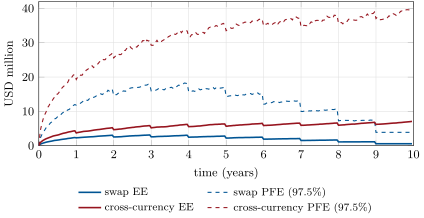
A bank receives fixed at the par rate of 3.80% on a USD 100 million ten-year swap (chapter 1’s SOFR curve, Hull–White with and a normal volatility of 90 basis points), and with the same counterparty receives USD fixed at 3.80% on USD 110 million and pays EUR fixed at the ESTR par rate of 2.59% on EUR 100 million for ten years, exchanging the notionals at the end (EURUSD at 1.10, volatility 8%). On 4 000 paths simulated every ten business days, the swap’s EE peaks at USD 3.13 million after three years and its PFE at USD 18.26 million after 3.9 years: rate risk grows with time and the remaining duration shrinks. The cross-currency swap’s EE rises to USD 7.09 million and its PFE to USD 39.93 million just before maturity, driven by the final exchange (Figure 17.1).
Example 17.12 (A counterparty that weakens with the euro)
Let the counterparty of the cross-currency swap have a hazard rate of : a 10% fall of the euro below its forward raises its hazard by about 70%. The bank’s exposure is largest when the euro has fallen. Weighting the paths by the probability of default in each period, the expected exposure conditional on default is 2.52 times the unconditional EE at its peak, and 2.22 times on average over the life (Figure 17.5).