جميع الكتب

مهني

1 Markets I: The Ecosystem and Exchange-Traded Marketsالأسواق عبر الإنترنت 2 Markets II: Rates, FX and Creditالأسواق عبر الإنترنت 3 Markets III: Commodities, Energy and Cryptoالأسواق عبر الإنترنت 4 Quantitative Methodsالأساليب عبر الإنترنت 5 Derivatives and Volatilityالمشتقات عبر الإنترنت 6 Rates, Credit, XVA and Riskالفائدة والائتمان والمخاطر عبر الإنترنت 7 Research Craft: Predictors, Backtests, Measurement, Portfoliosالبحث عبر الإنترنت 8 Strategies I: Equities and Futuresالاستراتيجيات عبر الإنترنت 9 Strategies II: Volatility, Relative Value, Macro and the Bank Desksالاستراتيجيات عبر الإنترنت 10 Microstructure and Executionالتنفيذ عبر الإنترنت 11 Market Making and High-Frequency Tradingصناعة السوق عبر الإنترنت 12 Machine Learning for Marketsتعلم الآلة عبر الإنترنت 13 Low-Latency Softwareالتكنولوجيا عبر الإنترنت 14 Networks, Hardware and Trading Infrastructureالتكنولوجيا عبر الإنترنت 15 Research, Data and Risk Platformsالتكنولوجيا عبر الإنترنت 16 The Desk and the Firmالشركة عبر الإنترنت 17 The Industry: Firms, Roles and Careersالمسارات المهنية عبر الإنترنت 18 The Interview Bookالمسارات المهنية عبر الإنترنت
التطبيقات حول المدرب تسجيل الدخول ابدأ القراءة

Quantitative Finance · المسرد

ما معنى Forward variance؟

Definition 12.1 Derivatives and Volatility · الفصل 12 — Rough Volatility and Forward-Variance Models

The forward variance for date uu seen at time t≤ut\le u is ξt(u)=EtQ[vu]\xi_t(u)=\E^{\mathbb Q}_t[v_u], the pricing-measure expectation of the instantaneous variance at uu. The curve u↦ξt(u)u\mapsto\xi_t(u) is the forward-variance curve; ξ0\xi_0 is today’s.

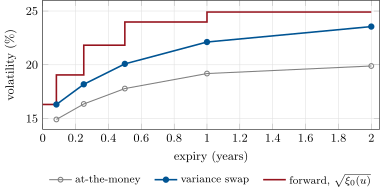
The forward-variance curve of chapter 9’s surface. The variance-swap volatility comes from each expiry’s option strip and lies above the at-the-money volatility because the strip weights the skewed puts. Its forward is piecewise constant between the pillars. Data: the chapter’s code.
Figure 12.1. The forward-variance curve of chapter 9’s surface. The variance-swap volatility comes from each expiry’s option strip and lies above the at-the-money volatility because the strip weights the skewed puts. Its forward is piecewise constant between the pillars. Data: the chapter’s code.

أمثلة

Example 12.2 (The forward-variance curve of chapter 9’s surface)

Integrating each expiry’s strip on chapter 9’s surface gives variance-swap volatilities of 16.3%, 18.2%, 20.1%, 22.1% and 23.6% at one month, three months, six months, one year and two years, against at-the-money volatilities of 14.9%, 16.4%, 17.8%, 19.2% and 19.9%. With total variance linear between the pillars, the forward volatility ξ0\sqrt{\xi_0} is 16.3% up to one month, then 19.1%, 21.8%, 24.0% and, from one to two years, 24.9% (Figure 12.1).

Example 12.11 (The VIX in rough Bergomi)

With the parameters of Example 12.8, the one-month VIX has E[VIX2]=0.0400\E[\mathrm{VIX}^2]=0.0400, the forward variance, as it must. The future is 18.74 against a forward variance-swap volatility of 20: a convexity gap of 1.26 points. The implied volatility of one-month VIX options is 123.1% at a strike of 80% of the future, 123.9% at the money and 125.7% at 160%. The model’s VIX is nearly lognormal, and its smile is nearly flat, with a level set by η\eta and HH. Guerreiro and Guerra make the same observation, and contrast it with the upward-sloping VIX smiles of the market.

اقرأ في الفصل →