Todos los libros

Profesional

Apps Acerca de Coach Iniciar sesión Empezar a leer

Quantitative Finance · Glosario

¿Qué es Fractional Brownian motion?

Definition 17.11 Quantitative Methods · Capítulo 17 — Linear Time Series

Fractional Brownian motion with Hurst exponent H∈(0,1)H \in (0, 1) is the centred Gaussian process with BH(0)=0B_H(0) = 0 and E[BH(t)BH(s)]=12(t2H+s2H−∣t−s∣2H)\E[B_H(t)B_H(s)] = \frac12(t^{2H} + s^{2H} - |t - s|^{2H}) (Mandelbrot and Van Ness, 1968). For H=12H = \frac12 it is Brownian motion; for H>12H > \frac12 its increments are positively correlated with power-law decay, for H<12H < \frac12 negatively.

Autocorrelations of a long-memory process (ARFIMA with d = 0.3: 20 000 simulated observations and the exact (h) = _i h(i - 1 + d)/(i - d), a straight line of slope 2d - 1 on these axes) and of an AR(1) with the same lag-one autocorrelation, which decays geometrically. Data: the chapter’s tutorial, seeded.
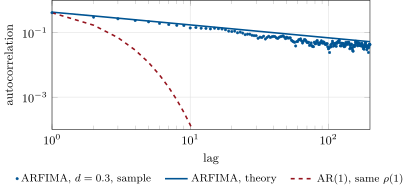
Figure 17.4. Autocorrelations of a long-memory process (ARFIMA with d=0.3d = 0.3: 20 000 simulated observations and the exact ρ(h)=∏i≤h(i−1+d)/(i−d)\rho(h) = \prod_{i \le h}(i - 1 + d)/(i - d), a straight line of slope 2d−12d - 1 on these axes) and of an AR(1) with the same lag-one autocorrelation, which decays geometrically. Data: the chapter’s tutorial, seeded.
Leer en el capítulo →