
All books

Professional

Apps About Coach Log in Start reading

Quantitative Finance · Glossary

What is Hayashi–Yoshida estimator, refresh-time sampling?

Also known as: Hayashi--Yoshida estimator · refresh-time sampling

Definition 21.8 Quantitative Methods · Chapter 21 — High-Frequency Econometrics

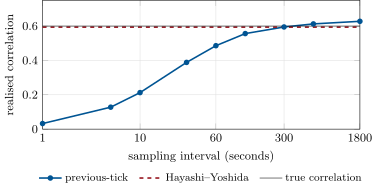
The Hayashi–Yoshida estimator (Hayashi and Yoshida, 2005) of the covariation sums the products of all pairs of returns, one from each asset, whose observation intervals overlap, with no interpolation. Refresh-time sampling samples both assets at the first time each has traded since the previous sampling time.
The Epps effect: realised correlation of two simulated stocks (true correlation 0.6) that trade at independent Poisson times, on average every 5 and 15 seconds, against the sampling interval, averaged over forty days; and the Hayashi–Yoshida estimate from all the trades (0.594). Data: the chapter’s tutorial, seeded.
Figure 21.4. The Epps effect: realised correlation of two simulated stocks (true correlation 0.6) that trade at independent Poisson times, on average every 5 and 15 seconds, against the sampling interval, averaged over forty days; and the Hayashi–Yoshida estimate from all the trades (0.594). Data: the chapter’s tutorial, seeded.
Read in context →