جميع الكتب

مهني

1 Markets I: The Ecosystem and Exchange-Traded Marketsالأسواق عبر الإنترنت 2 Markets II: Rates, FX and Creditالأسواق عبر الإنترنت 3 Markets III: Commodities, Energy and Cryptoالأسواق عبر الإنترنت 4 Quantitative Methodsالأساليب عبر الإنترنت 5 Derivatives and Volatilityالمشتقات عبر الإنترنت 6 Rates, Credit, XVA and Riskالفائدة والائتمان والمخاطر عبر الإنترنت 7 Research Craft: Predictors, Backtests, Measurement, Portfoliosالبحث عبر الإنترنت 8 Strategies I: Equities and Futuresالاستراتيجيات عبر الإنترنت 9 Strategies II: Volatility, Relative Value, Macro and the Bank Desksالاستراتيجيات عبر الإنترنت 10 Microstructure and Executionالتنفيذ عبر الإنترنت 11 Market Making and High-Frequency Tradingصناعة السوق عبر الإنترنت 12 Machine Learning for Marketsتعلم الآلة عبر الإنترنت 13 Low-Latency Softwareالتكنولوجيا عبر الإنترنت 14 Networks, Hardware and Trading Infrastructureالتكنولوجيا عبر الإنترنت 15 Research, Data and Risk Platformsالتكنولوجيا عبر الإنترنت 16 The Desk and the Firmالشركة عبر الإنترنت 17 The Industry: Firms, Roles and Careersالمسارات المهنية عبر الإنترنت 18 The Interview Bookالمسارات المهنية عبر الإنترنت
التطبيقات حول المدرب تسجيل الدخول ابدأ القراءة

Quantitative Finance · المسرد

ما معنى Hazard rate, survival probability؟

يُعرف أيضًا باسم: hazard rate · survival probability

Definition 23.3 Markets II: Rates, FX and Credit · الفصل 23 — Credit Default Swaps

The hazard rate λ(t)\lambda(t) of a reference entity is its instantaneous rate of default at time tt given survival to tt: the probability of default in [t,t+dt][t, t + dt], given no default before tt, is λ(t) dt\lambda(t)\,dt. The survival probability to TT is Q(T)=exp⁡(−∫0Tλ(u) du)Q(T) = \exp\bigl(-\int_0^T \lambda(u)\,du\bigr), which is e−λTe^{-\lambda T} for a flat hazard rate.

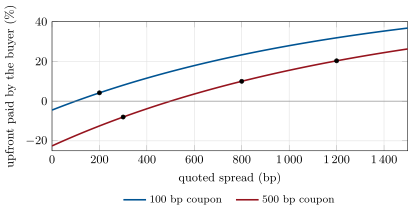
Upfront payment of a five-year contract, in per cent of notional, against the quoted spread, for the two standard coupons (flat rate 4%, recovery 40%). The upfront is zero where the spread equals the coupon, and negative, paid to the buyer, below it; the dots are . Illustrative; data: the chapter’s tutorial.
Figure 23.2. Upfront payment of a five-year contract, in per cent of notional, against the quoted spread, for the two standard coupons (flat rate 4%, recovery 40%). The upfront is zero where the spread equals the coupon, and negative, paid to the buyer, below it; the dots are Example 23.6. Illustrative; data: the chapter’s tutorial.
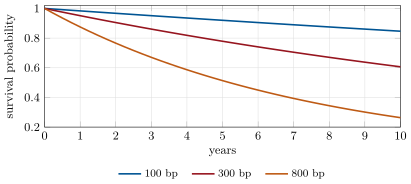
Survival probabilities implied by five-year spreads of 100, 300 and 800 basis points with a flat hazard rate and a recovery of 40%. The hazard rates are close to spread divided by 1 - R: about 1.7%, 5% and 13% a year. These are risk-neutral probabilities, which include a premium for bearing default risk. Illustrative; data: the chapter’s tutorial.
Figure 23.3. Survival probabilities implied by five-year spreads of 100, 300 and 800 basis points with a flat hazard rate and a recovery of 40%. The hazard rates are close to spread divided by 1−R1 - R: about 1.7%, 5% and 13% a year. These are risk-neutral probabilities, which include a premium for bearing default risk. Illustrative; data: the chapter’s tutorial.

أمثلة

Example 23.6 (Two quotes, two conventions)

With a flat rate of 4% and a recovery of 40%, the five-year risky annuity is 4.332 at a spread of 100 basis points and 4.165 at 200. An investment-grade name quoted at 200 basis points, on the 100 basis point coupon, costs the buyer 1%×4.165=4.16%1\% \times 4.165 = 4.16\% upfront, USD 416 000 on USD 10 million. A high-yield name quoted at 300 basis points on the 500 coupon pays the buyer 8.01% upfront; at 800 the buyer pays 9.98%, and at 1 200, 20.28%. Investment-grade names are quoted in spread, high-yield names in points upfront.

اقرأ في الفصل →