सभी किताबें

पेशेवर

ऐप्स परिचय Coach लॉग इन पढ़ना शुरू करें

Quantitative Finance · शब्दावली

Hazard rate, survival probability क्या है?

अन्य नाम: hazard rate · survival probability

Definition 23.3 Markets II: Rates, FX and Credit · अध्याय 23 — Credit Default Swaps

The hazard rate λ(t)\lambda(t) of a reference entity is its instantaneous rate of default at time tt given survival to tt: the probability of default in [t,t+dt][t, t + dt], given no default before tt, is λ(t) dt\lambda(t)\,dt. The survival probability to TT is Q(T)=exp⁡(−∫0Tλ(u) du)Q(T) = \exp\bigl(-\int_0^T \lambda(u)\,du\bigr), which is e−λTe^{-\lambda T} for a flat hazard rate.

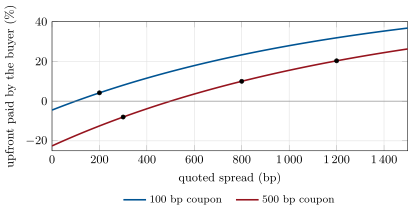
Upfront payment of a five-year contract, in per cent of notional, against the quoted spread, for the two standard coupons (flat rate 4%, recovery 40%). The upfront is zero where the spread equals the coupon, and negative, paid to the buyer, below it; the dots are . Illustrative; data: the chapter’s tutorial.
Figure 23.2. Upfront payment of a five-year contract, in per cent of notional, against the quoted spread, for the two standard coupons (flat rate 4%, recovery 40%). The upfront is zero where the spread equals the coupon, and negative, paid to the buyer, below it; the dots are Example 23.6. Illustrative; data: the chapter’s tutorial.
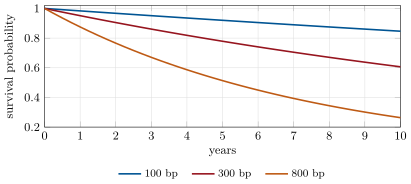
Survival probabilities implied by five-year spreads of 100, 300 and 800 basis points with a flat hazard rate and a recovery of 40%. The hazard rates are close to spread divided by 1 - R: about 1.7%, 5% and 13% a year. These are risk-neutral probabilities, which include a premium for bearing default risk. Illustrative; data: the chapter’s tutorial.
Figure 23.3. Survival probabilities implied by five-year spreads of 100, 300 and 800 basis points with a flat hazard rate and a recovery of 40%. The hazard rates are close to spread divided by 1−R1 - R: about 1.7%, 5% and 13% a year. These are risk-neutral probabilities, which include a premium for bearing default risk. Illustrative; data: the chapter’s tutorial.

उदाहरण

Example 23.6 (Two quotes, two conventions)

With a flat rate of 4% and a recovery of 40%, the five-year risky annuity is 4.332 at a spread of 100 basis points and 4.165 at 200. An investment-grade name quoted at 200 basis points, on the 100 basis point coupon, costs the buyer 1%×4.165=4.16%1\% \times 4.165 = 4.16\% upfront, USD 416 000 on USD 10 million. A high-yield name quoted at 300 basis points on the 500 coupon pays the buyer 8.01% upfront; at 800 the buyer pays 9.98%, and at 1 200, 20.28%. Investment-grade names are quoted in spread, high-yield names in points upfront.

अध्याय में पढ़ें →