 Coach
CoachA hierarchical model gives the parameters of many units a common prior whose own parameters are unknown: , . Empirical Bayes estimates from the data, by maximising the marginal likelihood or by moments, and then applies the posterior formulas of each unit with the estimates plugged in.
Ejemplos
Example 14.7 (Fifty managers)
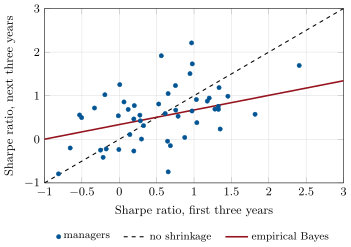
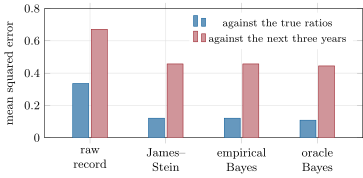
The platform’s fifty managers have true annual Sharpe ratios drawn from , and each three-year record adds noise of standard deviation (chapter 11). On the seeded platform, whose best record is 2.41 as in the hook, the records have mean 0.51 and standard deviation 0.71, so and : two thirds of every deviation from the mean is noise. The best record becomes , with posterior standard deviation 0.33; James–Stein gives 1.20. The second and third records, 1.82 and 1.45, become 0.95 and 0.83; the ranking does not change, only the distances. The true ratios of the top three are 1.07, 0.96 and 1.68, and their next three years deliver 1.69, 0.57 and 0.99 (Figure 14.1).