All books

Professional

Apps About Coach Log in Start reading

Quantitative Finance · Glossary

What is Huber loss, median absolute deviation?

Also known as: Huber loss · median absolute deviation

Definition 15.3 Quantitative Methods · Chapter 15 — Robust Statistics and Heavy Tails

The Huber loss with threshold cc is ρc(r)=r2/2\rho_c(r) = r^2/2 for ∣r∣≤c|r| \le c and c∣r∣−c2/2c|r| - c^2/2 otherwise; the Huber M-estimator of location minimises ∑iρc((xi−μ)/s)\sum_i\rho_c((x_i - \mu)/s) for a robust scale ss, so its estimating function ψc(r)=max⁡(−c,min⁡(c,r))\psi_c(r) = \max(-c, \min(c, r)) is bounded (Huber, 1964). The median absolute deviation is MAD=1.4826 medi∣xi−medjxj∣\mathrm{MAD} = 1.4826\,\mathrm{med}_i|x_i - \mathrm{med}_jx_j|, the constant making it consistent for the standard deviation of a normal law.

Three estimates of the daily volatility of EUR/USD from the 250 reference-rate returns to 23 September 2026, when the log price of 24 March 2026 carries an error. The dot is the transposed-digit print 1.5172 for 1.1572 (an error of 27.1%): standard deviation 2.43% instead of 0.34%, MAD 0.279% instead of 0.275%, Q_n 0.305% instead of 0.300%. Data: ECB euro reference rates (source: ECB statistics).
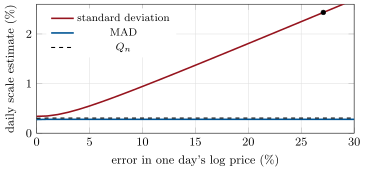
Figure 15.1. Three estimates of the daily volatility of EUR/USD from the 250 reference-rate returns to 23 September 2026, when the log price of 24 March 2026 carries an error. The dot is the transposed-digit print 1.5172 for 1.1572 (an error of 27.1%): standard deviation 2.43% instead of 0.34%, MAD 0.279% instead of 0.275%, QnQ_n 0.305% instead of 0.300%. Data: ECB euro reference rates (source: ECB statistics).
Read in context →