
सभी किताबें

पेशेवर

1 Markets I: The Ecosystem and Exchange-Traded Marketsबाज़ार ऑनलाइन 2 Markets II: Rates, FX and Creditबाज़ार ऑनलाइन 3 Markets III: Commodities, Energy and Cryptoबाज़ार ऑनलाइन 4 Quantitative Methodsविधियाँ ऑनलाइन 5 Derivatives and Volatilityडेरिवेटिव्स ऑनलाइन 6 Rates, Credit, XVA and Riskब्याज दरें, क्रेडिट और जोखिम ऑनलाइन 7 Research Craft: Predictors, Backtests, Measurement, Portfoliosअनुसंधान ऑनलाइन 8 Strategies I: Equities and Futuresरणनीतियाँ ऑनलाइन 9 Strategies II: Volatility, Relative Value, Macro and the Bank Desksरणनीतियाँ ऑनलाइन 10 Microstructure and Executionनिष्पादन ऑनलाइन 11 Market Making and High-Frequency Tradingमार्केट मेकिंग ऑनलाइन 12 Machine Learning for Marketsमशीन लर्निंग ऑनलाइन 13 Low-Latency Softwareतकनीक ऑनलाइन 14 Networks, Hardware and Trading Infrastructureतकनीक ऑनलाइन 15 Research, Data and Risk Platformsतकनीक ऑनलाइन 16 The Desk and the Firmफ़र्म ऑनलाइन 17 The Industry: Firms, Roles and Careersकरियर ऑनलाइन 18 Interviews I: Maths, Probability and Speedकरियर ऑनलाइन 19 Interviews II: Markets, Trading Games and the Final Roundकरियर ऑनलाइन 20 Interviews III: Codeकरियर ऑनलाइन
ऐप्स परिचय Coach लॉग इन पढ़ना शुरू करें

Quantitative Finance · शब्दावली

Imbalance bar क्या है?

Definition 2.2 Research Craft: Predictors, Backtests, Measurement, Portfolios · अध्याय 2 — Market Data for Research

An imbalance bar closes when the absolute sum of the trade signs since its start, ∣θ∣=∣∑bi∣|\theta| = |\sum b_i|, reaches a threshold set from the bars already closed: the expected number of trades per bar times the expected absolute imbalance per trade (López de Prado’s tick-imbalance bar), floored at the square root of the expected number of trades.
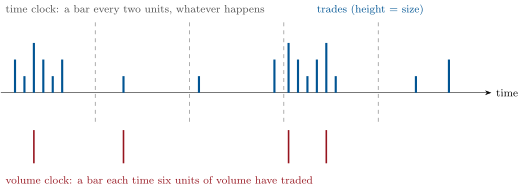
The same seventeen trades cut by two clocks. The time clock closes five equal intervals (dashed): three nearly empty, one holding the early burst and one the burst between t = 6 and 7. The volume clock (solid, below) closes four bars: two short ones inside the bursts, ending at 0.7 and 6.9, and two long ones that absorb the quiet stretches; the last three trades wait for the next bar.
Figure 2.1. The same seventeen trades cut by two clocks. The time clock closes five equal intervals (dashed): three nearly empty, one holding the early burst and one the burst between t=6t = 6 and 7. The volume clock (solid, below) closes four bars: two short ones inside the bursts, ending at 0.7 and 6.9, and two long ones that absorb the quiet stretches; the last three trades wait for the next bar.
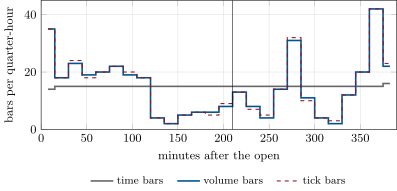
Bars closed per quarter-hour on the simulated day, each clock cutting about 390 bars. The time clock closes 15 bars in every quarter-hour; the volume and tick clocks follow the activity: busy after the open, quiet in the middle of the day, busy around the news burst at minute 210 (vertical line) and before the close. Dollar bars coincide with volume bars at this scale. Data: firm.tape, the chapter’s day, seeded.
Figure 2.2. Bars closed per quarter-hour on the simulated day, each clock cutting about 390 bars. The time clock closes 15 bars in every quarter-hour; the volume and tick clocks follow the activity: busy after the open, quiet in the middle of the day, busy around the news burst at minute 210 (vertical line) and before the close. Dollar bars coincide with volume bars at this scale. Data: firm.tape, the chapter’s day, seeded.
अध्याय में पढ़ें →