
Todos los libros

Profesional

Apps Acerca de Coach Iniciar sesión Empezar a leer

Quantitative Finance · Glosario

¿Qué es Impulse response function, forecast-error variance decomposition?

También llamado: impulse response function · forecast-error variance decomposition

Definition 20.3 Quantitative Methods · Capítulo 20 — Multivariate Series and Cointegration

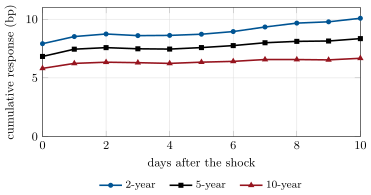
The impulse response function gives the effect on Yt+hY_{t+h} of a one-standard-deviation shock at tt; with correlated shocks, they are first orthogonalised by the Cholesky factor of Σ\Sigma, which makes the result depend on the ordering of the variables. The forecast-error variance decomposition gives the share of each variable’s hh-step forecast-error variance attributable to each orthogonalised shock.
Cumulative orthogonalised responses of the 2-, 5- and 10-year yields to a one-standard-deviation (7.9 bp) shock to the 2-year, from a VAR(10) of daily changes, 1976–2026, ordered 2-, 5-, 10-year. Data: FRED series DGS2, DGS5 and DGS10 (Board of Governors of the Federal Reserve System, H.15).
Figure 20.1. Cumulative orthogonalised responses of the 2-, 5- and 10-year yields to a one-standard-deviation (7.9 bp) shock to the 2-year, from a VAR(10) of daily changes, 1976–2026, ordered 2-, 5-, 10-year. Data: FRED series DGS2, DGS5 and DGS10 (Board of Governors of the Federal Reserve System, H.15).
Leer en el capítulo →