
All books

Professional

Apps About Coach Log in Start reading

Quantitative Finance · Glossary

What is Last look, hold time, reject rate?

Also known as: last look · hold time · reject rate

Definition 15.3 Markets II: Rates, FX and Credit · Chapter 15 — FX Spot Microstructure

Last look is a practice by which a liquidity provider receiving a trade request at its quoted price has a final opportunity, a short window after the request arrives, to accept or reject it. The hold time is the length of that window; the reject rate is the share of requests rejected. The price check can be asymmetric, rejecting only requests whose price has moved in the client’s favour beyond a threshold, or symmetric, rejecting moves beyond it in either direction.
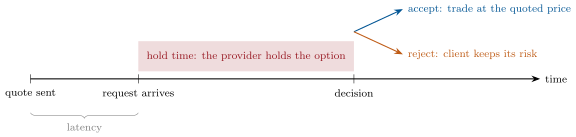
The life of a request under last look. The quote reaches the client, the client’s request reaches the provider after a latency, and the provider decides at the end of the hold time whether to trade at the price it quoted. During the hold the provider, not the client, holds the choice. Schematic.
Figure 15.1. The life of a request under last look. The quote reaches the client, the client’s request reaches the provider after a latency, and the provider decides at the end of the hold time whether to trade at the price it quoted. During the hold the provider, not the client, holds the choice. Schematic.
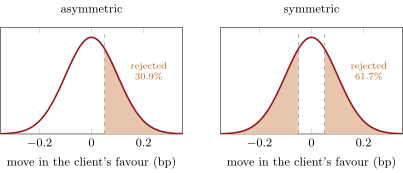
The move of the price during a 100-millisecond hold, for an uninformed request (standard deviation 0.1 basis points), and the requests rejected with a 0.05-basis-point threshold (shaded). The asymmetric check rejects only the right tail, whose mean the client loses; the symmetric one rejects both tails, which cancel. Illustrative.
Figure 15.2. The move of the price during a 100-millisecond hold, for an uninformed request (standard deviation 0.1 basis points), and the requests rejected with a 0.05-basis-point threshold (shaded). The asymmetric check rejects only the right tail, whose mean the client loses; the symmetric one rejects both tails, which cancel. Illustrative.

Examples

Example 15.5 (The cost of a window)

With the stream’s volatility, 0.1 basis points over 100 milliseconds, an asymmetric check with a threshold of 0.05 basis points and a 100-millisecond hold takes 0.1 φ(0.5)=0.03520.1\,\varphi(0.5) = 0.0352 basis points per request from uninformed clients; with no threshold, 0.0399. On USD 2 billion of requests a day this is about USD 7 041 a day, USD 1.76 million over 250 trading days. The symmetric check with the same threshold rejects 62% of the requests and takes nothing on average.

Read in context →