
सभी किताबें

पेशेवर

1 Markets I: The Ecosystem and Exchange-Traded Marketsबाज़ार ऑनलाइन 2 Markets II: Rates, FX and Creditबाज़ार ऑनलाइन 3 Markets III: Commodities, Energy and Cryptoबाज़ार ऑनलाइन 4 Quantitative Methodsविधियाँ ऑनलाइन 5 Derivatives and Volatilityडेरिवेटिव्स ऑनलाइन 6 Rates, Credit, XVA and Riskब्याज दरें, क्रेडिट और जोखिम ऑनलाइन 7 Research Craft: Predictors, Backtests, Measurement, Portfoliosअनुसंधान ऑनलाइन 8 Strategies I: Equities and Futuresरणनीतियाँ ऑनलाइन 9 Strategies II: Volatility, Relative Value, Macro and the Bank Desksरणनीतियाँ ऑनलाइन 10 Microstructure and Executionनिष्पादन ऑनलाइन 11 Market Making and High-Frequency Tradingमार्केट मेकिंग ऑनलाइन 12 Machine Learning for Marketsमशीन लर्निंग ऑनलाइन 13 Low-Latency Softwareतकनीक ऑनलाइन 14 Networks, Hardware and Trading Infrastructureतकनीक ऑनलाइन 15 Research, Data and Risk Platformsतकनीक ऑनलाइन 16 The Desk and the Firmफ़र्म ऑनलाइन 17 The Industry: Firms, Roles and Careersकरियर ऑनलाइन 18 Interviews I: Maths, Probability and Speedकरियर ऑनलाइन 19 Interviews II: Markets, Trading Games and the Final Roundकरियर ऑनलाइन 20 Interviews III: Codeकरियर ऑनलाइन
ऐप्स परिचय Coach लॉग इन पढ़ना शुरू करें

Quantitative Finance · शब्दावली

Last look, hold time, reject rate क्या है?

अन्य नाम: last look · hold time · reject rate

Definition 15.3 Markets II: Rates, FX and Credit · अध्याय 15 — FX Spot Microstructure

Last look is a practice by which a liquidity provider receiving a trade request at its quoted price has a final opportunity, a short window after the request arrives, to accept or reject it. The hold time is the length of that window; the reject rate is the share of requests rejected. The price check can be asymmetric, rejecting only requests whose price has moved in the client’s favour beyond a threshold, or symmetric, rejecting moves beyond it in either direction.
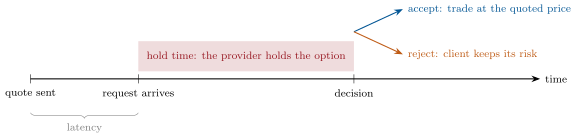
The life of a request under last look. The quote reaches the client, the client’s request reaches the provider after a latency, and the provider decides at the end of the hold time whether to trade at the price it quoted. During the hold the provider, not the client, holds the choice. Schematic.
Figure 15.1. The life of a request under last look. The quote reaches the client, the client’s request reaches the provider after a latency, and the provider decides at the end of the hold time whether to trade at the price it quoted. During the hold the provider, not the client, holds the choice. Schematic.
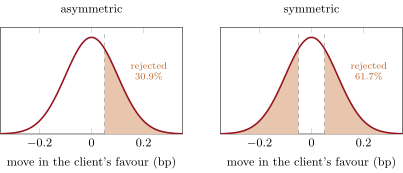
The move of the price during a 100-millisecond hold, for an uninformed request (standard deviation 0.1 basis points), and the requests rejected with a 0.05-basis-point threshold (shaded). The asymmetric check rejects only the right tail, whose mean the client loses; the symmetric one rejects both tails, which cancel. Illustrative.
Figure 15.2. The move of the price during a 100-millisecond hold, for an uninformed request (standard deviation 0.1 basis points), and the requests rejected with a 0.05-basis-point threshold (shaded). The asymmetric check rejects only the right tail, whose mean the client loses; the symmetric one rejects both tails, which cancel. Illustrative.

उदाहरण

Example 15.5 (The cost of a window)

With the stream’s volatility, 0.1 basis points over 100 milliseconds, an asymmetric check with a threshold of 0.05 basis points and a 100-millisecond hold takes 0.1 φ(0.5)=0.03520.1\,\varphi(0.5) = 0.0352 basis points per request from uninformed clients; with no threshold, 0.0399. On USD 2 billion of requests a day this is about USD 7 041 a day, USD 1.76 million over 250 trading days. The symmetric check with the same threshold rejects 62% of the requests and takes nothing on average.

अध्याय में पढ़ें →