
جميع الكتب

مهني

1 Markets I: The Ecosystem and Exchange-Traded Marketsالأسواق عبر الإنترنت 2 Markets II: Rates, FX and Creditالأسواق عبر الإنترنت 3 Markets III: Commodities, Energy and Cryptoالأسواق عبر الإنترنت 4 Quantitative Methodsالأساليب عبر الإنترنت 5 Derivatives and Volatilityالمشتقات عبر الإنترنت 6 Rates, Credit, XVA and Riskالفائدة والائتمان والمخاطر عبر الإنترنت 7 Research Craft: Predictors, Backtests, Measurement, Portfoliosالبحث عبر الإنترنت 8 Strategies I: Equities and Futuresالاستراتيجيات عبر الإنترنت 9 Strategies II: Volatility, Relative Value, Macro and the Bank Desksالاستراتيجيات عبر الإنترنت 10 Microstructure and Executionالتنفيذ عبر الإنترنت 11 Market Making and High-Frequency Tradingصناعة السوق عبر الإنترنت 12 Machine Learning for Marketsتعلم الآلة عبر الإنترنت 13 Low-Latency Softwareالتكنولوجيا عبر الإنترنت 14 Networks, Hardware and Trading Infrastructureالتكنولوجيا عبر الإنترنت 15 Research, Data and Risk Platformsالتكنولوجيا عبر الإنترنت 16 The Desk and the Firmالشركة عبر الإنترنت 17 The Industry: Firms, Roles and Careersالمسارات المهنية عبر الإنترنت 18 The Interview Bookالمسارات المهنية عبر الإنترنت
التطبيقات حول المدرب تسجيل الدخول ابدأ القراءة

Quantitative Finance · المسرد

ما معنى Last look, hold time, reject rate؟

يُعرف أيضًا باسم: last look · hold time · reject rate

Definition 15.3 Markets II: Rates, FX and Credit · الفصل 15 — FX Spot Microstructure

Last look is a practice by which a liquidity provider receiving a trade request at its quoted price has a final opportunity, a short window after the request arrives, to accept or reject it. The hold time is the length of that window; the reject rate is the share of requests rejected. The price check can be asymmetric, rejecting only requests whose price has moved in the client’s favour beyond a threshold, or symmetric, rejecting moves beyond it in either direction.
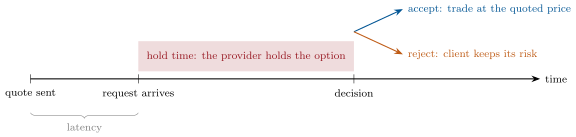
The life of a request under last look. The quote reaches the client, the client’s request reaches the provider after a latency, and the provider decides at the end of the hold time whether to trade at the price it quoted. During the hold the provider, not the client, holds the choice. Schematic.
Figure 15.1. The life of a request under last look. The quote reaches the client, the client’s request reaches the provider after a latency, and the provider decides at the end of the hold time whether to trade at the price it quoted. During the hold the provider, not the client, holds the choice. Schematic.
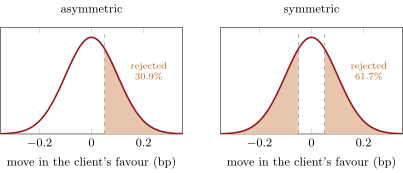
The move of the price during a 100-millisecond hold, for an uninformed request (standard deviation 0.1 basis points), and the requests rejected with a 0.05-basis-point threshold (shaded). The asymmetric check rejects only the right tail, whose mean the client loses; the symmetric one rejects both tails, which cancel. Illustrative.
Figure 15.2. The move of the price during a 100-millisecond hold, for an uninformed request (standard deviation 0.1 basis points), and the requests rejected with a 0.05-basis-point threshold (shaded). The asymmetric check rejects only the right tail, whose mean the client loses; the symmetric one rejects both tails, which cancel. Illustrative.

أمثلة

Example 15.5 (The cost of a window)

With the stream’s volatility, 0.1 basis points over 100 milliseconds, an asymmetric check with a threshold of 0.05 basis points and a 100-millisecond hold takes 0.1 φ(0.5)=0.03520.1\,\varphi(0.5) = 0.0352 basis points per request from uninformed clients; with no threshold, 0.0399. On USD 2 billion of requests a day this is about USD 7 041 a day, USD 1.76 million over 250 trading days. The symmetric check with the same threshold rejects 62% of the requests and takes nothing on average.

اقرأ في الفصل →