
جميع الكتب

مهني

1 Markets I: The Ecosystem and Exchange-Traded Marketsالأسواق عبر الإنترنت 2 Markets II: Rates, FX and Creditالأسواق عبر الإنترنت 3 Markets III: Commodities, Energy and Cryptoالأسواق عبر الإنترنت 4 Quantitative Methodsالأساليب عبر الإنترنت 5 Derivatives and Volatilityالمشتقات عبر الإنترنت 6 Rates, Credit, XVA and Riskالفائدة والائتمان والمخاطر عبر الإنترنت 7 Research Craft: Predictors, Backtests, Measurement, Portfoliosالبحث عبر الإنترنت 8 Strategies I: Equities and Futuresالاستراتيجيات عبر الإنترنت 9 Strategies II: Volatility, Relative Value, Macro and the Bank Desksالاستراتيجيات عبر الإنترنت 10 Microstructure and Executionالتنفيذ عبر الإنترنت 11 Market Making and High-Frequency Tradingصناعة السوق عبر الإنترنت 12 Machine Learning for Marketsتعلم الآلة عبر الإنترنت 13 Low-Latency Softwareالتكنولوجيا عبر الإنترنت 14 Networks, Hardware and Trading Infrastructureالتكنولوجيا عبر الإنترنت 15 Research, Data and Risk Platformsالتكنولوجيا عبر الإنترنت 16 The Desk and the Firmالشركة عبر الإنترنت 17 The Industry: Firms, Roles and Careersالمسارات المهنية عبر الإنترنت 18 The Interview Bookالمسارات المهنية عبر الإنترنت
التطبيقات حول المدرب تسجيل الدخول ابدأ القراءة

Quantitative Finance · المسرد

ما معنى Layer-1 switch, fan-out, multiplexer؟

يُعرف أيضًا باسم: layer-1 switch · layer-1 fan-out · layer-1 multiplexer

Definition 2.4 Networks, Hardware and Trading Infrastructure · الفصل 2 — Switches and Layer-1 Devices

A layer-1 switch connects ports at the level of the electrical or optical signal: it regenerates the bits of one input on the outputs configured for it without decoding frames, so it neither reads addresses nor queues. A layer-1 fan-out is a configuration that copies one input to several outputs at once. A layer-1 multiplexer merges the frames of several inputs onto one output; unlike a fan-out it must recognise frame boundaries and hold a frame that arrives while another is being sent.
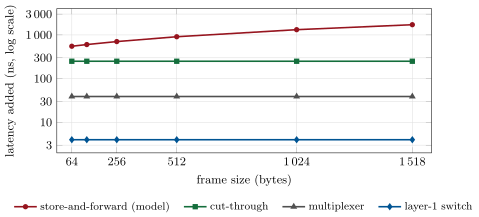
Latency each device adds to a frame at 10\, G bit/ s, egress idle, by frame size. Only the store-and-forward switch grows with the frame (its internal time of 500\, n s is a model value); the others use the data-sheet figures of . Data: fig_cage.py.
Figure 2.2. Latency each device adds to a frame at 10 Gbit/s10\,\mathrm{G}\mathrm{bit}/\mathrm{s}, egress idle, by frame size. Only the store-and-forward switch grows with the frame (its internal time of 500 ns500\,\mathrm{n}\mathrm{s} is a model value); the others use the data-sheet figures of Box 2.1. Data: fig_cage.py.

أمثلة

Example 2.6 (Two servers, one handoff)

A 100-byte order occupies 96 ns96\,\mathrm{n}\mathrm{s} of line time at 10 Gbit/s10\,\mathrm{G}\mathrm{bit}/\mathrm{s}. If two of the firm’s servers answer the same market event with delays of standard deviation 50 ns50\,\mathrm{n}\mathrm{s}, the second order waits with probability 2Φ(96/70.7)−1=0.832\Phi(96/70.7) - 1 = 0.83. The firm’s own servers are competing with each other at the multiplexer at the moment that matters most, and the one whose response was faster by a few nanoseconds is the one that goes first.

اقرأ في الفصل →