
सभी किताबें

पेशेवर

1 Markets I: The Ecosystem and Exchange-Traded Marketsबाज़ार ऑनलाइन 2 Markets II: Rates, FX and Creditबाज़ार ऑनलाइन 3 Markets III: Commodities, Energy and Cryptoबाज़ार ऑनलाइन 4 Quantitative Methodsविधियाँ ऑनलाइन 5 Derivatives and Volatilityडेरिवेटिव्स ऑनलाइन 6 Rates, Credit, XVA and Riskब्याज दरें, क्रेडिट और जोखिम ऑनलाइन 7 Research Craft: Predictors, Backtests, Measurement, Portfoliosअनुसंधान ऑनलाइन 8 Strategies I: Equities and Futuresरणनीतियाँ ऑनलाइन 9 Strategies II: Volatility, Relative Value, Macro and the Bank Desksरणनीतियाँ ऑनलाइन 10 Microstructure and Executionनिष्पादन ऑनलाइन 11 Market Making and High-Frequency Tradingमार्केट मेकिंग ऑनलाइन 12 Machine Learning for Marketsमशीन लर्निंग ऑनलाइन 13 Low-Latency Softwareतकनीक ऑनलाइन 14 Networks, Hardware and Trading Infrastructureतकनीक ऑनलाइन 15 Research, Data and Risk Platformsतकनीक ऑनलाइन 16 The Desk and the Firmफ़र्म ऑनलाइन 17 The Industry: Firms, Roles and Careersकरियर ऑनलाइन 18 Interviews I: Maths, Probability and Speedकरियर ऑनलाइन 19 Interviews II: Markets, Trading Games and the Final Roundकरियर ऑनलाइन 20 Interviews III: Codeकरियर ऑनलाइन
ऐप्स परिचय Coach लॉग इन पढ़ना शुरू करें

Quantitative Finance · शब्दावली

Layer-1 switch, fan-out, multiplexer क्या है?

अन्य नाम: layer-1 switch · layer-1 fan-out · layer-1 multiplexer

Definition 2.4 Networks, Hardware and Trading Infrastructure · अध्याय 2 — Switches and Layer-1 Devices

A layer-1 switch connects ports at the level of the electrical or optical signal: it regenerates the bits of one input on the outputs configured for it without decoding frames, so it neither reads addresses nor queues. A layer-1 fan-out is a configuration that copies one input to several outputs at once. A layer-1 multiplexer merges the frames of several inputs onto one output; unlike a fan-out it must recognise frame boundaries and hold a frame that arrives while another is being sent.
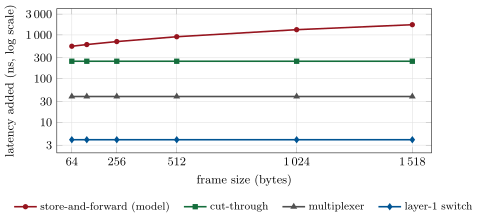
Latency each device adds to a frame at 10\, G bit/ s, egress idle, by frame size. Only the store-and-forward switch grows with the frame (its internal time of 500\, n s is a model value); the others use the data-sheet figures of . Data: fig_cage.py.
Figure 2.2. Latency each device adds to a frame at 10 Gbit/s10\,\mathrm{G}\mathrm{bit}/\mathrm{s}, egress idle, by frame size. Only the store-and-forward switch grows with the frame (its internal time of 500 ns500\,\mathrm{n}\mathrm{s} is a model value); the others use the data-sheet figures of Box 2.1. Data: fig_cage.py.

उदाहरण

Example 2.6 (Two servers, one handoff)

A 100-byte order occupies 96 ns96\,\mathrm{n}\mathrm{s} of line time at 10 Gbit/s10\,\mathrm{G}\mathrm{bit}/\mathrm{s}. If two of the firm’s servers answer the same market event with delays of standard deviation 50 ns50\,\mathrm{n}\mathrm{s}, the second order waits with probability 2Φ(96/70.7)−1=0.832\Phi(96/70.7) - 1 = 0.83. The firm’s own servers are competing with each other at the multiplexer at the moment that matters most, and the one whose response was faster by a few nanoseconds is the one that goes first.

अध्याय में पढ़ें →