جميع الكتب

مهني

1 Markets I: The Ecosystem and Exchange-Traded Marketsالأسواق عبر الإنترنت 2 Markets II: Rates, FX and Creditالأسواق عبر الإنترنت 3 Markets III: Commodities, Energy and Cryptoالأسواق عبر الإنترنت 4 Quantitative Methodsالأساليب عبر الإنترنت 5 Derivatives and Volatilityالمشتقات عبر الإنترنت 6 Rates, Credit, XVA and Riskالفائدة والائتمان والمخاطر عبر الإنترنت 7 Research Craft: Predictors, Backtests, Measurement, Portfoliosالبحث عبر الإنترنت 8 Strategies I: Equities and Futuresالاستراتيجيات عبر الإنترنت 9 Strategies II: Volatility, Relative Value, Macro and the Bank Desksالاستراتيجيات عبر الإنترنت 10 Microstructure and Executionالتنفيذ عبر الإنترنت 11 Market Making and High-Frequency Tradingصناعة السوق عبر الإنترنت 12 Machine Learning for Marketsتعلم الآلة عبر الإنترنت 13 Low-Latency Softwareالتكنولوجيا عبر الإنترنت 14 Networks, Hardware and Trading Infrastructureالتكنولوجيا عبر الإنترنت 15 Research, Data and Risk Platformsالتكنولوجيا عبر الإنترنت 16 The Desk and the Firmالشركة عبر الإنترنت 17 The Industry: Firms, Roles and Careersالمسارات المهنية عبر الإنترنت 18 The Interview Bookالمسارات المهنية عبر الإنترنت
التطبيقات حول المدرب تسجيل الدخول ابدأ القراءة

Quantitative Finance · المسرد

ما معنى Leverage function؟

Definition 20.10 Derivatives and Volatility · الفصل 20 — FX Derivatives

The leverage function L(t,S)L(t,S) of a stochastic-local volatility model is the function that makes the model reprice every vanilla. By the Markovian projection of chapter 9 it satisfies

L(t,S)2 E[vt∣St=S]=σloc(t,S)2,L(t,S)^2\,\E\bigl[v_t\mid S_t=S\bigr]=\sigma_{\mathrm{loc}}(t,S)^2,

with σloc(t,S)\sigma_{\mathrm{loc}}(t,S) the market’s local volatility.

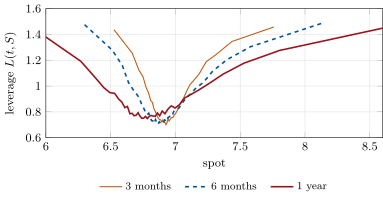
The leverage function of the stochastic-local volatility model (mixing 0.5) calibrated by the particle method to the chapter’s pair, at three dates, over the range the particles cover. Below one near the forward, above one in the wings: the local part supplies the smile that half the volatility of variance leaves out. Data: the tutorial.
Figure 20.4. The leverage function of the stochastic-local volatility model (mixing 0.5) calibrated by the particle method to the chapter’s pair, at three dates, over the range the particles cover. Below one near the forward, above one in the wings: the local part supplies the smile that half the volatility of variance leaves out. Data: the tutorial.

أمثلة

Example 20.11 (The leverage function of the pair)

With mixing λ=0.5\lambda=0.5, the calibrated L(t,S)L(t,S) near the forward is 0.76 at three months, 0.73 at six months and 0.79 at one year. It rises to about 1.4 or 1.5 in both wings (Figure 20.4). All three models reprice the one-year smile: at the 10-delta put, the 25-delta put, the at-the-money straddle, the 25-delta call and the 10-delta call, stochastic-local volatility gives 5.22%, 4.90%, 5.38%, 6.77% and 8.96%, against the market’s 5.14%, 4.84%, 5.32%, 6.72% and 8.91%. The differences, below a tenth of a point, come from the simulation’s daily Euler steps.

اقرأ في الفصل →