Semua buku

Profesional

Aplikasi Tentang Pelatih Masuk Mulai membaca

Quantitative Finance · Glosarium

Apa itu Leverage function?

Definition 20.10 Derivatives and Volatility · Bab 20 — FX Derivatives

The leverage function L(t,S)L(t,S) of a stochastic-local volatility model is the function that makes the model reprice every vanilla. By the Markovian projection of chapter 9 it satisfies

L(t,S)2 E[vt∣St=S]=σloc(t,S)2,L(t,S)^2\,\E\bigl[v_t\mid S_t=S\bigr]=\sigma_{\mathrm{loc}}(t,S)^2,

with σloc(t,S)\sigma_{\mathrm{loc}}(t,S) the market’s local volatility.

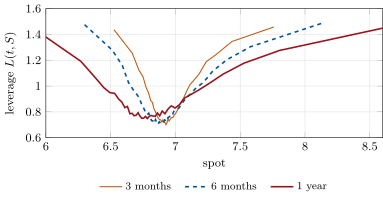
The leverage function of the stochastic-local volatility model (mixing 0.5) calibrated by the particle method to the chapter’s pair, at three dates, over the range the particles cover. Below one near the forward, above one in the wings: the local part supplies the smile that half the volatility of variance leaves out. Data: the tutorial.
Figure 20.4. The leverage function of the stochastic-local volatility model (mixing 0.5) calibrated by the particle method to the chapter’s pair, at three dates, over the range the particles cover. Below one near the forward, above one in the wings: the local part supplies the smile that half the volatility of variance leaves out. Data: the tutorial.

Contoh

Example 20.11 (The leverage function of the pair)

With mixing λ=0.5\lambda=0.5, the calibrated L(t,S)L(t,S) near the forward is 0.76 at three months, 0.73 at six months and 0.79 at one year. It rises to about 1.4 or 1.5 in both wings (Figure 20.4). All three models reprice the one-year smile: at the 10-delta put, the 25-delta put, the at-the-money straddle, the 25-delta call and the 10-delta call, stochastic-local volatility gives 5.22%, 4.90%, 5.38%, 6.77% and 8.96%, against the market’s 5.14%, 4.84%, 5.32%, 6.72% and 8.91%. The differences, below a tenth of a point, come from the simulation’s daily Euler steps.

Baca dalam konteks →