 Coach
CoachA likelihood-ratio Greek differentiates the density of the simulated state instead of the payoff: it averages the discounted payoff times the score, the derivative of the log-density with respect to the parameter; it works for discontinuous payoffs, at the cost of a higher variance.
Voorbeelden
Example 23.9 (Twelve vegas for the price of three passes)
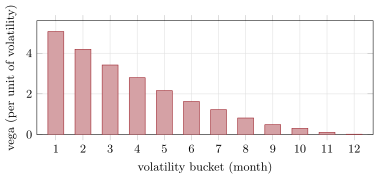
An arithmetic Asian call (one year, 48 steps, strike 100, 20%) is priced along with its sensitivity to the volatility in each of twelve monthly buckets. Forward mode would need one pass per bucket. The adjoint (reverse) pass of One Quant Book 4, chapter 28, runs once backwards along each stored path and accumulates the derivative of the payoff with respect to every step’s state and volatility. It returns all twelve vegas and the delta at a cost of a few forward passes. The price is 5.901 and the delta 0.593. The vega of the first month is 5.064, where bumping that month’s volatility with the same draws gives 5.065, and the vegas fall to 0.016 for the last month (Figure 23.3).