Todos os livros

Profissional

Apps Sobre Coach Entrar Começar a ler

Quantitative Finance · Glossário

O que é Margin valuation adjustment?

Definition 19.4 Rates, Credit, XVA and Risk · Capítulo 19 — Funding, Margin and Capital Adjustments

The margin valuation adjustment (MVA) is the value of the cost of funding the initial margin a position requires over its life: MVA=∫0T(sf−rIM) E[IM(t)] P(0,t) dt\mathrm{MVA} = \int_0^T(s_f-r_{\mathrm{IM}})\,\E[\mathrm{IM}(t)]\,P(0,t)\,dt.

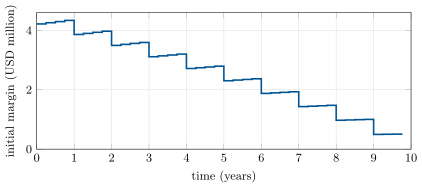
Expected initial margin of the ten-year swap under a sensitivity-based model: it starts at USD 4.22 million and falls with the swap’s remaining DV01. Its funding cost over the life is the MVA. Data: the chapter’s tutorial.
Figure 19.2. Expected initial margin of the ten-year swap under a sensitivity-based model: it starts at USD 4.22 million and falls with the swap’s remaining DV01. Its funding cost over the life is the MVA. Data: the chapter’s tutorial.

Exemplos

Example 19.5 (MVA of the swap)

With Book 2’s sensitivity model, initial margin is 2.326 standard deviations of the swap’s value over ten days at a rate volatility of 7 basis points a day: USD 4.22 million today, falling as the swap’s DV01 runs off (Figure 19.2). Funding it at 80 basis points costs USD 175 217 over the swap’s life.

Ler no capítulo →