جميع الكتب

مهني

1 Markets I: The Ecosystem and Exchange-Traded Marketsالأسواق عبر الإنترنت 2 Markets II: Rates, FX and Creditالأسواق عبر الإنترنت 3 Markets III: Commodities, Energy and Cryptoالأسواق عبر الإنترنت 4 Quantitative Methodsالأساليب عبر الإنترنت 5 Derivatives and Volatilityالمشتقات عبر الإنترنت 6 Rates, Credit, XVA and Riskالفائدة والائتمان والمخاطر عبر الإنترنت 7 Research Craft: Predictors, Backtests, Measurement, Portfoliosالبحث عبر الإنترنت 8 Strategies I: Equities and Futuresالاستراتيجيات عبر الإنترنت 9 Strategies II: Volatility, Relative Value, Macro and the Bank Desksالاستراتيجيات عبر الإنترنت 10 Microstructure and Executionالتنفيذ عبر الإنترنت 11 Market Making and High-Frequency Tradingصناعة السوق عبر الإنترنت 12 Machine Learning for Marketsتعلم الآلة عبر الإنترنت 13 Low-Latency Softwareالتكنولوجيا عبر الإنترنت 14 Networks, Hardware and Trading Infrastructureالتكنولوجيا عبر الإنترنت 15 Research, Data and Risk Platformsالتكنولوجيا عبر الإنترنت 16 The Desk and the Firmالشركة عبر الإنترنت 17 The Industry: Firms, Roles and Careersالمسارات المهنية عبر الإنترنت 18 The Interview Bookالمسارات المهنية عبر الإنترنت
التطبيقات حول المدرب تسجيل الدخول ابدأ القراءة

Quantitative Finance · المسرد

ما معنى Netting set, close-out netting؟

يُعرف أيضًا باسم: netting set · close-out netting

Definition 17.5 Rates, Credit, XVA and Risk · الفصل 17 — Counterparty Exposure

A netting set is the group of trades with one counterparty under one legally enforceable master agreement. Close-out netting lets the surviving party terminate every trade of the netting set on default and set the values off against each other into one net amount, so the exposure is max⁡(∑iVi,0)\max(\sum_iV_i,0), not ∑imax⁡(Vi,0)\sum_i\max(V_i,0).

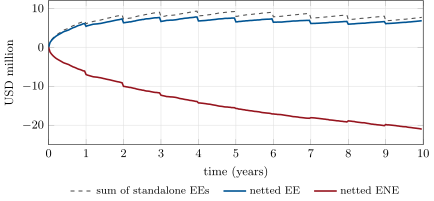
Netting the swap and the cross-currency swap: the netted EE lies below the sum of the standalone EEs, and the netted ENE is larger in size than the EE because the netting set drifts in the counterparty’s favour. Data: the chapter’s tutorial.
Figure 17.2. Netting the swap and the cross-currency swap: the netted EE lies below the sum of the standalone EEs, and the netted ENE is larger in size than the EE because the netting set drifts in the counterparty’s favour. Data: the chapter’s tutorial.

أمثلة

Example 17.6 (The netting benefit)

Netted, the two trades of Example 17.4 have an EE that peaks at USD 7.77 million after 3.9 years, where the two standalone EEs add to USD 9.24 million: a 16% saving (Figure 17.2). The netting set’s ENE reaches −USD 21.0-\text{USD}~21.0 million: the bank pays the lower-rate currency and the final exchange is at a forward rate above spot, so the trade drifts in the counterparty’s favour.

Example 17.10 (Collateralising the netting set)

Under a two-way CSA with zero threshold and a minimum transfer amount of USD 500 000, the netting set’s EE falls to a nearly flat USD 1.30 million at its peak and its PFE to USD 6.45 million with a margin period of risk of ten business days; the EPE over the life falls from USD 6.44 million to 0.95 million, 15% of the uncollateralised figure. With twenty days the peak EE is USD 1.83 million, 2\sqrt2 times higher; with a threshold of USD 10 million it is USD 3.81 million (Figure 17.4).

اقرأ في الفصل →