
All books

Professional

Apps About Coach Log in Start reading

Quantitative Finance · Glossary

What is Overcollateralisation test, interest-coverage test, equity tranche?

Also known as: overcollateralisation test · interest-coverage test · equity tranche

Definition 25.4 Markets II: Rates, FX and Credit · Chapter 25 — Loans, CLOs and Securitisation

An overcollateralisation test compares the par value of the loans with the notes outstanding down to a given class; an interest-coverage test compares the interest collected with the interest due on those notes. Each has a trigger ratio, and when a ratio falls below it, cash that would have gone further down the waterfall repays the most senior notes instead. The equity tranche of a securitisation is its most junior claim, unrated, which receives whatever cash is left after every other claim has been paid.
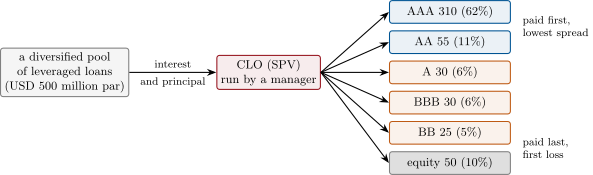
The illustrative CLO of this chapter: a managed pool of leveraged loans held by a special-purpose vehicle and funded by five classes of rated notes and 10% equity, in USD millions. Cash is paid down the stack in order; losses are taken up from the bottom. Schematic; the structure is illustrative.
Figure 25.1. The illustrative CLO of this chapter: a managed pool of leveraged loans held by a special-purpose vehicle and funded by five classes of rated notes and 10% equity, in USD millions. Cash is paid down the stack in order; losses are taken up from the bottom. Schematic; the structure is illustrative.
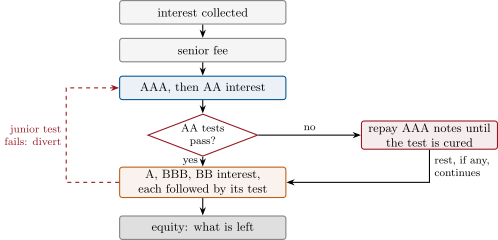
The interest waterfall of the chapter’s CLO. After each class is paid, its tests are checked; a failure diverts the remaining interest to repay the senior notes until the test is cured, and only what is left continues down to the equity. Schematic.
Figure 25.2. The interest waterfall of the chapter’s CLO. After each class is paid, its tests are checked; a failure diverts the remaining interest to repay the senior notes until the test is cured, and only what is left continues down to the equity. Schematic.

Examples

Example 25.5 (The excess spread)

The chapter’s CLO holds USD 500 million of loans paying 3.5% over a floating rate of 4%, USD 37.5 million a year. The manager’s fee of 0.45% costs USD 2.25 million, and the notes, from AAA at 1.30% over to BB at 6.00% over, cost USD 26.14 million. The equity, USD 50 million, receives USD 9.11 million a year, 18.2% of its investment; without defaults and with the loans sold at par after five years, its internal rate of return is 19.5%. The overcollateralisation ratios start at 1.370, 1.266, 1.176 and 1.111 at the AA, A, BBB and BB levels, against triggers of 1.25, 1.18, 1.10 and 1.05.

Read in context →