Markets II: Rates, FX and Credit · Markets
25Loans, CLOs and Securitisation
At the end of 2025 American companies owed USD 1.55 trillion of institutional leveraged loans, 9.2% more than a year before, by the Federal Reserve’s count. These are loans to companies with high debt, and they are not kept by the banks that arrange them: they are sold to institutional investors, and many end up in vehicles that buy a diversified pool of them and pay for it by selling notes of different seniority. Each vehicle’s documents say, to the dollar, who is paid first each quarter, and contain tests that, when the loans start to default, turn off the cash to the most junior investors and send it to the most senior. This chapter explains the loans, securitisation, the collateralised loan obligation and its waterfall, and who holds which part; the build is the waterfall itself.
25.1 The leveraged-loan market
Definition 25.1 (Leveraged loan, term loan B, covenant-lite)
A leveraged loan is a loan, usually senior and secured on the borrower’s assets and paying a floating rate plus a spread, to a company whose debt is high relative to its earnings or whose credit is rated below investment grade. A term loan B is the tranche of such a loan arranged to be sold to institutional investors: a long maturity, little amortisation before it, and tradable. A covenant-lite loan has no maintenance covenants, financial ratios the borrower must meet at every test date; it keeps only incurrence covenants, which are tested when the borrower takes an action such as borrowing more.
A bank arranges the loan, for example to finance a private-equity firm’s purchase of a company, and syndicates it: it sells most of it to loan funds, CLOs and other investors, who then trade it in a secondary market. Because the loan floats, the borrower’s interest bill moves with the policy rate of chapter 1; because the loan is senior and usually secured, its lenders tend to recover more after a default than bondholders do (chapter 23’s auctions show it); and when it is covenant-lite, they have fewer early warnings before one.
The Federal Reserve watches this market in its financial stability reports. In May 2026 it noted that the share of new loans to companies with debt of four or more times earnings had risen and stayed above its historical median, that the median borrower’s interest coverage was near its historical low, and that defaults including distressed exchanges, loans renegotiated when the borrower was in difficulty, remained relatively high.
As of September 2026 — The leveraged-loan and CLO markets
Institutional leveraged loans outstanding in the United States: USD 1 549 billion at the end of 2025, up 9.2% in a year and by 12.6% a year on average since 2000 (Federal Reserve, Financial Stability Report, May 2026, from PitchBook LCD data). CLOs: USD 264 billion in 2011, USD 617 billion in 2018 (Federal Reserve, 2019, from SIFMA data); no later public figure was fetched for this book.
25.2 Securitisation
Definition 25.2 (Securitisation, special-purpose vehicle)
Securitisation is the pooling of loans or other financial assets and the sale of claims on their cash flows as securities. A special-purpose vehicle (SPV) is a company set up only to hold the pool and issue the securities, so that the pool is separate from whoever originated or sold the assets and the investors’ claims depend only on it.
Securitisation turns a pool of assets into securities with different risks. The mortgage pass-through of chapter 12 passes the cash flows through pro rata; most other securitisations tranche them, as the index tranches of chapter 24 do, so that some investors are paid first and others absorb the first losses. Credit cards, car loans, commercial mortgages and leveraged loans are all securitised. The Federal Reserve notes that securitisation can add leverage to the financial system, because the vehicles are subject to lighter rules, such as risk retention, than banks’ capital requirements.
Risk retention requires the sponsor of a securitisation to keep a share of its credit risk, 5% under the American rule adopted under the Dodd–Frank Act, so that it has a stake in the quality of what it sells. For one kind of CLO, it does not apply: in February 2018 the federal appeals court in Washington held that managers of open-market CLOs, who neither originate the loans nor hold them before the vehicle does, are not the securitisers the rule covers, and vacated the rule as applied to them.
25.3 The CLO waterfall and its tests
Definition 25.3 (Collateralised loan obligation, payment waterfall)
A collateralised loan obligation (CLO) is an SPV that holds an actively managed, diversified portfolio of leveraged loans and funds it by issuing rated notes of decreasing seniority and unrated equity. Its payment waterfall is the order, fixed in its documents, in which the cash collected from the loans is paid out on each payment date.
Definition 25.4 (Overcollateralisation test, interest-coverage test, equity tranche)
An overcollateralisation test compares the par value of the loans with the notes outstanding down to a given class; an interest-coverage test compares the interest collected with the interest due on those notes. Each has a trigger ratio, and when a ratio falls below it, cash that would have gone further down the waterfall repays the most senior notes instead. The equity tranche of a securitisation is its most junior claim, unrated, which receives whatever cash is left after every other claim has been paid.
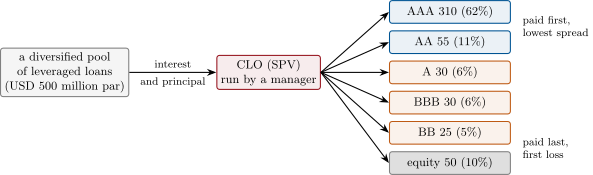
A manager selects the loans, trades them, and during a reinvestment period of several years replaces those that repay or default; the notes pay a floating rate plus a spread fixed at issue, and the equity is paid the difference between what the loans earn and what the notes cost, the excess spread, as long as the tests pass (Figure 25.1).
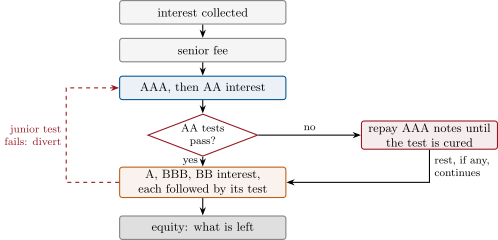
Each quarter the interest collected pays the manager’s senior fee, then the interest on each class in turn. After a class is paid, its tests are checked. If one fails, the interest left is used to repay the senior notes until the ratio is back at its trigger, and only what then remains continues down (Figure 25.2). Unpaid interest on the junior notes is not a default: it is added to their balance and paid later if it can be.
Example 25.5 (The excess spread)
The chapter’s CLO holds USD 500 million of loans paying 3.5% over a floating rate of 4%, USD 37.5 million a year. The manager’s fee of 0.45% costs USD 2.25 million, and the notes, from AAA at 1.30% over to BB at 6.00% over, cost USD 26.14 million. The equity, USD 50 million, receives USD 9.11 million a year, 18.2% of its investment; without defaults and with the loans sold at par after five years, its internal rate of return is 19.5%. The overcollateralisation ratios start at 1.370, 1.266, 1.176 and 1.111 at the AA, A, BBB and BB levels, against triggers of 1.25, 1.18, 1.10 and 1.05.
Proposition 25.6 (The overcollateralisation cushion)
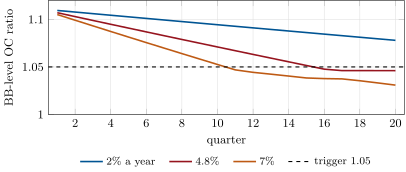
If the notes down to a class total , the loans have par and the class’s trigger is , the test fails once the par has fallen by more than . With recoveries reinvested at par, each unit of defaulted par lowers the portfolio’s par by , so the test fails once cumulative defaults exceed .
Proof. The test is . Before any diversion is unchanged, so it fails when , a fall of . A default of removes of par and the reinvested recovery adds back , a net fall of . ∎
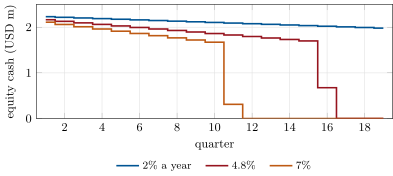
For the BB test, : with a recovery of 70%, USD 91.7 million of defaults, 18.3% of the portfolio, trip it. Once it fails, the cure takes roughly the par lost each quarter, divided by the trigger, out of the interest that would have gone down the waterfall; when that exceeds what is left after the notes’ interest, the equity receives nothing (Figure 25.3).
25.4 Who holds which tranche
The notes are sold to investors whose needs match their risk: American CLO investors are typically banks, mutual funds, insurance companies, pension funds and hedge funds. The AAA notes pay a small spread over the floating rate for protection by 38% of subordination in the chapter’s example, which suits investors that need high ratings and floating-rate assets; the mezzanine notes pay more for thinner protection; the equity is a leveraged position in the loans, about ten times, and earns the excess spread, which suits investors who can bear large losses in a bad cycle. The manager is paid fees senior to all the notes, whatever happens to the equity.
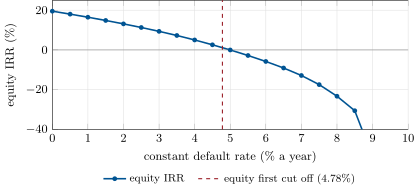
The structure makes the equity’s returns very sensitive to defaults (Figure 25.4). Its internal rate of return falls from 19.5% without defaults to 13.1% at 2% a year and 5.0% at 4%, and it is negative from about 5%. The AAA notes, protected by the subordination and by the tests, which turn the equity’s cash into repayments, are paid in full in every case the tutorial runs, even at 10% a year.
25.5 Tutorial: a CLO waterfall through a default wave
Goal. Build the waterfall, run the chapter’s CLO through constant default rates, watch the overcollateralisation test divert cash, and find the default rate at which the equity stops being paid. End state: Figures 25.3 and 25.4, Example 25.5 and the numbers of the weekend problem.
The deal: notes, triggers and the quarterly record.
@dataclass
class Note:
    name: str
    balance: float
    spread: float                      # over the floating rate, a year
    deferrable: bool = True


@dataclass
class Deal:
    notes: list[Note]
    par: float                         # loan portfolio at par
    loan_spread: float
    rate: float                        # floating rate, flat
    fee: float                         # senior fee, a year, on par
    oc: dict[int, float]               # class index -> trigger on par / notes up to that class
    ic: dict[int, float] = field(default_factory=dict)   # class index -> trigger on interest cover
    recovery: float = 0.70
    quarters: int = 20
    reinvest_quarters: int = 20


@dataclass
class Period:
    quarter: int
    par: float
    oc_ratios: dict[int, float]
    diverted: float
    equity: float
    balances: list[float]
Listing 25.1. Notes, the deal’s terms and a period’s record. code/firm/waterfall/firm_waterfall.py The waterfall: defaults, reinvestment, interest by class, tests and diversions (
pay_downrepays the notes in order), the final sale.def run(deal: Deal, cdr: float) -> list[Period]: notes = [Note(n.name, n.balance, n.spread, n.deferrable) for n in deal.notes] par, out, q_default = deal.par, [], 1.0 - (1.0 - cdr) ** 0.25 for t in range(1, deal.quarters + 1): defaults = par * q_default par -= defaults interest = par * (deal.rate + deal.loan_spread) / 4 recoveries = defaults * deal.recovery if t <= deal.reinvest_quarters: par += recoveries principal = 0.0 else: principal = recoveries avail = max(interest - deal.fee * deal.par / 4, 0.0) cash_after_fee, due_so_far, diverted, ratios = avail, 0.0, 0.0, {} for k, n in enumerate(notes): due = n.balance * (deal.rate + n.spread) / 4 due_so_far += due paid = min(avail, due) avail -= paid if n.deferrable: n.balance += due - paid senior = sum(m.balance for m in notes[:k + 1]) if k in deal.oc: ratios[k] = par / senior if senior > 0 else float("inf") if ratios[k] < deal.oc[k]: cure = min(avail, senior - par / deal.oc[k]) pay_down(notes, cure) avail -= cure diverted += cure if k in deal.ic and due_so_far > 0 and cash_after_fee / due_so_far < deal.ic[k]: pay_down(notes, avail) diverted += avail avail = 0.0 avail += pay_down(notes, principal) if t == deal.quarters: avail += pay_down(notes, par) out.append(Period(t, par, ratios, diverted, avail, [n.balance for n in notes])) return outListing 25.2. The quarterly waterfall. code/firm/waterfall/firm_waterfall.py The results: the equity’s internal rate of return and the lowest default rate at which it is cut off, by bisection.
def equity_irr(cash: list[float], invested: float) -> float:
    """Annual internal rate of return of quarterly equity cash flows (bisection on the quarterly rate)."""
    def npv(q: float) -> float:
        return -invested + sum(c / (1 + q) ** (t + 1) for t, c in enumerate(cash))
    lo, hi = -0.99, 1.0
    if npv(lo) < 0:
        return -1.0
    for _ in range(200):
        mid = 0.5 * (lo + hi)
        lo, hi = (mid, hi) if npv(mid) > 0 else (lo, mid)
    return (1 + 0.5 * (lo + hi)) ** 4 - 1


def cutoff_cdr(deal: Deal, lo: float = 0.0, hi: float = 0.5) -> float:
    """Lowest constant default rate at which the equity receives nothing in some quarter before the end."""
    def cut(cdr: float) -> bool:
        return any(p.equity < 1e-9 for p in run(deal, cdr)[:-1])
    for _ in range(60):
        mid = 0.5 * (lo + hi)
        lo, hi = (lo, mid) if cut(mid) else (mid, hi)
    return hi
Listing 25.3. Equity IRR and the cut-off default rate. code/firm/waterfall/firm_waterfall.py - Run
clo_demo.base_case(),clo_demo.problem()andfig_clo.py.
What to change next. Replace the constant default rate by a wave, 2% a year for two years, then 10% for one, then 2%, and compare the equity’s return with the constant rate that has the same cumulative defaults; then let the loans be sold at 95 instead of par at the end.
25.6 Build: the CLO waterfall engine
Purpose. The miniature firm’s credit desk values CLO notes and equity under default scenarios, and its risk team sees how close each deal is to its triggers.
Interface. Note(name, balance, spread, deferrable); Deal(notes, par, loan_spread, rate, fee, oc, ic, recovery, quarters, reinvest_quarters); run(deal, cdr) returning one Period per quarter; pay_down(notes, amount); equity_irr(cash, invested); cutoff_cdr(deal).
Rules. Quarterly; constant annual default rate; recoveries reinvested at par during the reinvestment period, used to repay notes after it; fee senior to all notes; deferrable junior interest; overcollateralisation cures limited to the interest available; an interest-coverage failure diverts all remaining interest; loans sold at par at the end.
Acceptance tests. code/firm/waterfall/tests/: without defaults every class is paid and the equity receives the excess spread and its principal; balances and payments never go negative; above the cut-off default rate the equity is cut off in some quarter, below it never.
Stretch. Loan-level pools with ratings and a CCC bucket haircut in the tests; default and prepayment scenarios from a credit model; the principal waterfall and reinvestment criteria; valuing each class by simulation (One Quant Book 6).
Sources and further reading
- Federal Reserve Board, Financial Stability Report, May 2026.
- M. Guse, W. Park, Z. Saravay and Y. Yook, “Collateralized loan obligations in the Financial Accounts of the United States”, FEDS Notes, September 2019.
- NAIC Capital Markets Bureau, “Middle market collateralized loan obligations primer”, March 2025.
- Chapman and Cutler, client alert on Loan Syndications and Trading Association v. SEC (D.C. Cir., 9 February 2018).
25.7 Exercises
Exercise 25.1 ★
Compute the four overcollateralisation ratios of the chapter’s CLO at issue.
Solution
Solution of Exercise 25.1.
, , and .
Exercise 25.2 ★
Why does a leveraged loan’s interest bill rise when the central bank raises rates, and a fixed-rate bond’s does not?
Solution
Solution of Exercise 25.2.
The loan pays a floating rate plus a fixed spread, reset each period from a short-term rate that follows the central bank’s policy rate; the bond’s coupon was fixed at issue.
Exercise 25.3 ★
What does a covenant-lite loan take away from its lenders?
Solution
Solution of Exercise 25.3.
The maintenance covenants: the right to act, to renegotiate or to accelerate, when the borrower’s ratios deteriorate, before it misses a payment. Lenders learn of trouble later and have less say until a default.
Exercise 25.4 ★★
With a recovery of 70%, how much of the portfolio must default before the A-level test (trigger 1.18) fails?
Solution
Solution of Exercise 25.4.
The par may fall by million; at a loss of 30% per default that is USD 113 million of defaults, 22.6% of the portfolio.
Exercise 25.5 ★★
Why did the court find that the risk-retention rule did not fit open-market CLO managers, and what incentive problem does risk retention address?
Solution
Solution of Exercise 25.5.
The rule applies to securitisers, who transfer assets into a securitisation; an open-market CLO manager neither originates the loans nor holds them before the vehicle buys them, so it has nothing to retain in that sense. Risk retention addresses originate-to-distribute: a lender that sells everything it makes has little reason to lend carefully.
Exercise 25.6 ★★
The equity is about ten times levered on the loans. Using Example 25.5, explain why its cash yield is 18.2% when the loans pay 3.5% over the floating rate.
Solution
Solution of Exercise 25.6.
The loans earn 7.5% on USD 500 million; the notes cost 5.81% on average on USD 450 million, and the fee 0.45% on the whole. The equity, USD 50 million, collects the difference on the whole pool: million, 18.2% of its investment, because its own small stake earns the spread earned on ten times as much.
Exercise 25.7 ★★★
Coding. End the reinvestment period after two years instead of five, so that recoveries repay the notes, and find the new cut-off default rate. Explain the change.
Solution
Solution of Exercise 25.7.
5.35% a year instead of 4.78%. After the reinvestment period, recoveries repay the AAA notes instead of buying new loans, which lowers the notes faster than the par and raises the coverage ratios, so the tests fail later.
Exercise 25.8 ★★★
Find the flaw. “The AAA notes of a CLO are as safe as the AAA bonds of a large company: same rating, same risk.” Correct it.
Solution
Solution of Exercise 25.8.
The CLO’s AAA notes are rated on the structure: their safety comes from subordination and tests against a pool of speculative-grade loans, and it depends on how defaults in the pool are correlated, which a single company’s bond does not. Their price can fall far more in a credit crisis, when correlation and downgrades rise together, and they are less liquid.
25.8 Problem: The Test That Trips
Problem 25.1
Weekend problem — when the equity stops being paid
An investor considers the equity of the chapter’s CLO: USD 500 million of loans at 3.5% over a floating rate of 4%, notes of USD 450 million in five classes, USD 50 million of equity, a senior fee of 0.45%, overcollateralisation triggers of 1.25, 1.18, 1.10 and 1.05 after the AA, A, BBB and BB classes, an interest-coverage trigger of 1.20 after the AA class, recoveries of 70% reinvested for five years, and the loans sold at par at the end.
Part I — The structure.
- What do the loans earn, and what do the fee and the notes cost, each year?
- What does the equity receive each year without defaults, and what cash yield is that?
- What is the equity’s return over five years without defaults?
- How far can the par fall before the BB-level test fails?
- What cumulative defaults is that, with a recovery of 70%?
Part II — Defaults.
- What is the equity’s return at constant default rates of 2%, 4% and 6% a year?
- How much cash is diverted over five years at 4%, 6% and 10%?
- Find the lowest constant default rate at which the equity receives nothing in some quarter.
- At that rate, in which quarter is the equity first cut off, and how much par has the portfolio lost?
- What happens to the BB notes at 10% a year?
Part III — Levers.
- How does ending the reinvestment period after two years change the cut-off?
- Why do the tests protect the AAA notes?
- Why is a loan that recovers 70% after default less damaging to the tests than a bond that recovers 40%?
- What would a manager do, when the test is close to failing, to keep the equity paid, and what are the risks?
- Why does it matter for the equity that the loans are sold at par at the end?
Part IV — Judgement.
- Which historical default rates would you compare 4.78% with, and why is a constant rate optimistic in a recession?
- Who should hold the equity, and who the AAA notes?
- How would you hedge the equity’s exposure to a default wave?
- State the named result: the default rate at which the equity stops receiving cash, and when.
- In one sentence: what does the overcollateralisation test do?
Solution
Solution of Problem 25.1.
1. USD 37.5 million; the fee USD 2.25 million, the notes USD 26.14 million. 2. USD 9.11 million, 18.2%. 3. 19.5% a year. 4. USD 27.5 million (). 5. USD 91.7 million, 18.3% of the portfolio. 6. 13.1%, 5.0% and . 7. USD 2.0, 12.5 and 28.4 million. 8. 4.78% a year. 9. In quarter 19, when the portfolio’s par has fallen by USD 33.6 million. 10. USD 6.5 million of its USD 25 million is not repaid, and the equity receives nothing from quarter 8. 11. It raises the cut-off to 5.35%: recoveries then repay the notes. 12. Every failure turns junior cash into repayments of the AAA notes, which lowers their balance faster than the pool loses par. 13. Each default lowers the par by the loss, 30% of the loan against 60% of the bond, so it uses up half as much of the cushion. 14. Sell weak loans before they default, or buy loans below par, which the tests may count at par; the first crystallises losses, the second adds risk, and both are limited by the documents. 15. It returns the equity’s share of the principal; if loans must be sold below par, as in a stressed market, that final payment shrinks or disappears. 16. With the realised default rates on leveraged loans, including distressed exchanges, in past recessions; defaults cluster in a recession, so a few years well above the average do more damage than the same total spread evenly. 17. The equity: investors who can bear large losses and value the excess spread; the AAA notes: investors who need high ratings and floating-rate assets, such as banks and insurers. 18. Buy protection on a high-yield credit index or on its junior tranche, which lose in the same default wave; the hedge is imperfect because the CLO’s loans are not the index’s names. 19. Named result: the test that trips cuts the equity off at a constant default rate of 4.78% a year, first in quarter 19, when the par has fallen by USD 33.6 million. 20. It takes cash from the equity and gives it to the senior notes as soon as losses eat into the cushion.
25.9 Interview questions
Interview question 25.1 ★ trader, researcher
What is a CLO, and who holds its tranches?
Solution
Solution of Interview question 25.1.
A vehicle holding an actively managed pool of leveraged loans, funded by notes rated from AAA to BB and by unrated equity; the cash flows pay the notes in order and the rest to the equity. Banks, insurers, funds and pension funds hold the rated notes; the equity goes to investors who can bear first losses.
What the interviewer is looking for: SPV, manager, tranches, investors by risk.
Interview question 25.2 ★ researcher, risk
How do overcollateralisation and interest-coverage tests work?
Solution
Solution of Interview question 25.2.
On each payment date, the ratio of loan par to the notes down to a class, and of interest collected to interest due, are compared with triggers; if one fails, the cash that would have gone further down repays the senior notes until the ratio is restored. Defaults, losses and downgraded loans move the ratios.
What the interviewer is looking for: par and interest ratios, triggers, diversion.
Interview question 25.3 ★★ researcher
How would you value a CLO equity tranche?
Solution
Solution of Interview question 25.3.
Model the pool’s defaults, recoveries, prepayments and rates, by scenario or simulation, with loan-level detail if available; run the waterfall for each path; the equity’s value is the discounted residual cash, at a rate reflecting its risk, and its sensitivity to the default and recovery assumptions is the main risk. Check the result against secondary prices.
What the interviewer is looking for: scenarios through the actual waterfall.
Interview question 25.4 ★★ trader, researcher
Compare a CLO tranche with a tranche of a credit index. What is different about its risk?
Solution
Solution of Interview question 25.4.
An index tranche is synthetic, static, of fixed maturity and marked daily from index spreads; a CLO tranche is cash, backed by a managed, changing pool of loans, with reinvestment and tests that move cash between classes, and trades rarely. Its risk depends on the manager and the documents, not only on default correlation.
What the interviewer is looking for: static versus managed, tests, liquidity.
Interview question 25.5 ★★ risk, bank
What are the risks of the leveraged-loan market for financial stability?
Solution
Solution of Interview question 25.5.
Rising leverage and weaker covenants among borrowers, floating-rate debt that makes them vulnerable to higher rates, concentration in some sectors, and the chain of holders (CLOs, funds, insurers and banks) through which losses spread; funds that promise liquidity against illiquid loans can face runs.
What the interviewer is looking for: borrower fragility and where the losses land.
Interview question 25.6 ★★★ developer
Design a system that runs the waterfalls of 2 000 CLOs under 10 000 scenarios each night.
Solution
Solution of Interview question 25.6.
Encode each deal’s waterfall as data (classes, tests, triggers, fees, dates) run by one engine rather than per-deal code; vectorise over scenarios; share the loan-level cash flows across deals that hold the same loans; run in parallel across deals and nodes; validate each deal against its trustee reports.
What the interviewer is looking for: waterfall as data, reuse, parallelism, validation.