
Todos os livros

Profissional

Apps Sobre Coach Entrar Começar a ler

Quantitative Finance · Glossário

O que é Pari passu clause?

Definition 26.4 Markets II: Rates, FX and Credit · Capítulo 26 — Distressed, Sovereign and Bank-Capital Credit

A pari passu clause states that a bond ranks equally with the issuer’s other unsecured debt of the same kind.
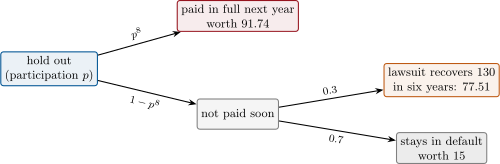
The holdout’s probability tree in the chapter’s example, values per 100 of old face discounted at 9%. The chance of being paid in full soon rises steeply with the share of creditors who tendered, since the sovereign can afford to pay a small remainder. Illustrative.
Figure 26.2. The holdout’s probability tree in the chapter’s example, values per 100 of old face discounted at 9%. The chance of being paid in full soon rises steeply with the share of creditors who tendered, since the sovereign can afford to pay a small remainder. Illustrative.
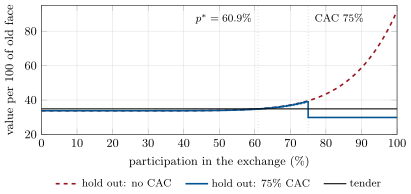
Value of holding out against the share of creditors who tender, without a collective action clause and with a 75% aggregated clause, and the value of tendering. Holding out pays above 60.9% participation; the clause removes the gain from 75%, where the holdout is bound to the offer and loses the cash paid to those who tendered. Illustrative; data: the chapter’s tutorial.
Figure 26.3. Value of holding out against the share of creditors who tender, without a collective action clause and with a 75% aggregated clause, and the value of tendering. Holding out pays above 60.9% participation; the clause removes the gain from 75%, where the holdout is bound to the offer and loses the cash paid to those who tendered. Illustrative; data: the chapter’s tutorial.

Exemplos

Example 26.6 (Where holding out pays)

In the tree of Figure 26.2, holding out is worth 33.75 if no one tenders, 34.73 at 60% participation and 38.97 at 74%, against 34.85 for tendering. It pays from a participation of 60.9%. With a 75% aggregated clause, at 75% or more the holdout is bound and receives the new bonds alone, 29.85: the band in which holding out pays is 60.9% to 75%. Without a clause it pays at any participation above 60.9%, and at 90% it is worth 58.72 (Figure 26.3).

Ler no capítulo →