
جميع الكتب

مهني

1 Markets I: The Ecosystem and Exchange-Traded Marketsالأسواق عبر الإنترنت 2 Markets II: Rates, FX and Creditالأسواق عبر الإنترنت 3 Markets III: Commodities, Energy and Cryptoالأسواق عبر الإنترنت 4 Quantitative Methodsالأساليب عبر الإنترنت 5 Derivatives and Volatilityالمشتقات عبر الإنترنت 6 Rates, Credit, XVA and Riskالفائدة والائتمان والمخاطر عبر الإنترنت 7 Research Craft: Predictors, Backtests, Measurement, Portfoliosالبحث عبر الإنترنت 8 Strategies I: Equities and Futuresالاستراتيجيات عبر الإنترنت 9 Strategies II: Volatility, Relative Value, Macro and the Bank Desksالاستراتيجيات عبر الإنترنت 10 Microstructure and Executionالتنفيذ عبر الإنترنت 11 Market Making and High-Frequency Tradingصناعة السوق عبر الإنترنت 12 Machine Learning for Marketsتعلم الآلة عبر الإنترنت 13 Low-Latency Softwareالتكنولوجيا عبر الإنترنت 14 Networks, Hardware and Trading Infrastructureالتكنولوجيا عبر الإنترنت 15 Research, Data and Risk Platformsالتكنولوجيا عبر الإنترنت 16 The Desk and the Firmالشركة عبر الإنترنت 17 The Industry: Firms, Roles and Careersالمسارات المهنية عبر الإنترنت 18 The Interview Bookالمسارات المهنية عبر الإنترنت
التطبيقات حول المدرب تسجيل الدخول ابدأ القراءة

Quantitative Finance · المسرد

ما معنى Particle filter, sequential importance resampling؟

يُعرف أيضًا باسم: particle filter · sequential importance resampling

Definition 19.9 Quantitative Methods · الفصل 19 — State-Space Models and the Kalman Filter

A particle filter represents the filtering law of a state by a weighted sample of particles. Sequential importance resampling, the bootstrap filter of Gordon, Salmond and Smith (1993), propagates each particle through the state equation, weights it by the density of the new observation given the particle, and resamples in proportion to the weights; the average weight at each step estimates the one-step predictive density, and their product the likelihood.
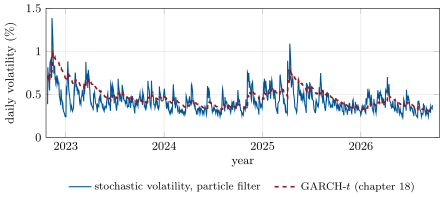
EUR/USD daily volatility over the last 1 000 ECB fixings to 23 September 2026: the particle-filtered stochastic-volatility estimate (= 0.9, _ = 0.4, 5 000 particles) and the GARCH-t conditional volatility. Data: ECB euro reference rates (source: ECB statistics).
Figure 19.5. EUR/USD daily volatility over the last 1 000 ECB fixings to 23 September 2026: the particle-filtered stochastic-volatility estimate (ϕ=0.9\phi = 0.9, ση=0.4\sigma_\eta = 0.4, 5 000 particles) and the GARCH-tt conditional volatility. Data: ECB euro reference rates (source: ECB statistics).
اقرأ في الفصل →