
Todos los libros

Profesional

Apps Acerca de Coach Iniciar sesión Empezar a leer

Quantitative Finance · Glosario

¿Qué es Point of non-viability, bail-in?

También llamado: point of non-viability · bail-in

Definition 26.8 Markets II: Rates, FX and Credit · Capítulo 26 — Distressed, Sovereign and Bank-Capital Credit

The point of non-viability is the moment an authority decides that a bank would fail without a write-down of its capital instruments or public support. A bail-in is the write-down or conversion into equity of a failing bank’s liabilities by an authority, so that creditors instead of taxpayers bear its losses.
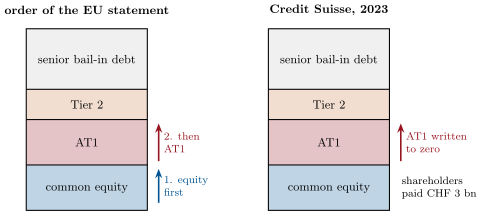
The loss-absorbing stack of a bank. The EU authorities stated in March 2023 that common equity absorbs losses first and AT1 only after its full use; in Credit Suisse’s case the AT1 bonds were written down under their contractual viability trigger and an emergency ordinance, while shareholders received UBS shares. Schematic; heights not to scale.
Figure 26.4. The loss-absorbing stack of a bank. The EU authorities stated in March 2023 that common equity absorbs losses first and AT1 only after its full use; in Credit Suisse’s case the AT1 bonds were written down under their contractual viability trigger and an emergency ordinance, while shareholders received UBS shares. Schematic; heights not to scale.

Ejemplos

Example 26.9 (Two orders of loss)

An illustrative bank has 45 of common equity, 16 of AT1, 12 of Tier 2 and 80 of senior debt eligible for bail-in, in billions. A loss of 20 absorbed in the order of the EU statement leaves equity with 25 and every bond intact. An AT1 write-down under a contractual trigger removes all 16 of the AT1 and leaves the equity with 45.

Leer en el capítulo →