全部书籍

专业

应用 关于 Coach 登录 开始阅读

书籍暂未推出简体中文版——当前显示英文版。

Quantitative Finance · 术语表

什么是 Proximal operator, proximal gradient method?

又称: proximal operator · proximal gradient method

Definition 24.7 Quantitative Methods · 第 24 章 — Numerical Optimisation in Practice

The proximal operator of a convex function gg is prox⁡tg(v)=arg⁡min⁡x(g(x)+12t∥x−v∥2)\operatorname{prox}_{tg}(v) = \arg\min_x\bigl(g(x) + \frac1{2t}\lVert x - v\rVert^2\bigr); for g=λ∥⋅∥1g = \lambda\lVert\cdot\rVert_1 it is soft thresholding. The proximal gradient method minimises f+gf + g, ff smooth, by xk+1=prox⁡g/L(xk−∇f(xk)/L)x_{k+1} = \operatorname{prox}_{g/L}(x_k - \nabla f(x_k)/L); FISTA (Beck and Teboulle, 2009) adds Nesterov’s extrapolation.
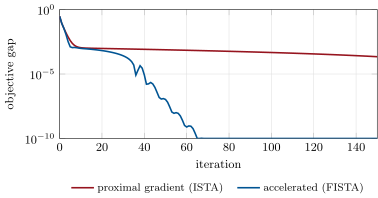
The lasso (= 0.1, 200 observations, 50 predictors with a near-collinear pair) by the proximal gradient method and its accelerated version: gap to the optimal objective against the iteration, floored at 10-10. Data: the chapter’s tutorial, seeded.
Figure 24.5. The lasso (λ=0.1\lambda = 0.1, 200 observations, 50 predictors with a near-collinear pair) by the proximal gradient method and its accelerated version: gap to the optimal objective against the iteration, floored at 10−1010^{-10}. Data: the chapter’s tutorial, seeded.
在原文中阅读 →
