
Tous les livres

Professionnel

Applis À propos Coach Connexion Commencer la lecture

Quantitative Finance · Glossaire

Qu'est-ce que « QLIKE loss, Mincer–Zarnowitz regression, Diebold–Mariano test » ?

Aussi appelé : QLIKE loss · Mincer--Zarnowitz regression · Diebold--Mariano test

Definition 18.9 Quantitative Methods · Chapitre 18 — Volatility Models

The QLIKE loss is σ^2/h+ln⁡h\hat\sigma^2/h + \ln h (up to terms that do not involve hh), the negative Gaussian log-likelihood of the proxy’s return: minimised in expectation by h=E[σ^2]h = \E[\hat\sigma^2] and heavier on under-prediction than on over-prediction. The Mincer–Zarnowitz regression (1969) of the proxy on the forecast, σ^t2=a+bht+et\hat\sigma^2_t = a + bh_t + e_t, tests unbiasedness (a=0a = 0, b=1b = 1). The Diebold–Mariano test (1995) of equal accuracy divides the mean loss difference of two forecasts by its HAC standard error.
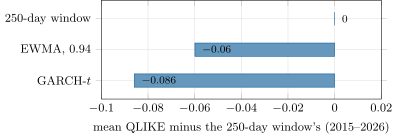
Out-of-sample accuracy of three one-day EUR/USD variance forecasts, 2015–2026 (3 002 days), as mean QLIKE relative to the 250-day window (lower is better): GARCH-t fitted on 1999–2014 -0.086, EWMA -0.060. Both differences are significant by the Diebold–Mariano test. Data: ECB euro reference rates (source: ECB statistics).
Figure 18.5. Out-of-sample accuracy of three one-day EUR/USD variance forecasts, 2015–2026 (3 002 days), as mean QLIKE relative to the 250-day window (lower is better): GARCH-tt fitted on 1999–2014 −0.086-0.086, EWMA −0.060-0.060. Both differences are significant by the Diebold–Mariano test. Data: ECB euro reference rates (source: ECB statistics).
Lire dans le chapitre →