
All books

Professional

Apps About Coach Log in Start reading

Quantitative Finance · Glossary

What is Risk-neutral density and the Breeden–Litzenberger formula?

Also known as: risk-neutral density · Breeden--Litzenberger formula

Definition 7.6 Derivatives and Volatility · Chapter 7 — Implied Volatility and Its Surface

The risk-neutral density of STS_T is the density qT(s)q_T(s) of the underlying at TT under the risk-neutral measure (One Quant Book 4, chapter 5); it is the continuous version of the state prices of chapter 1, divided by the discount factor. The Breeden–Litzenberger formula reads it off call prices:
qT(K)=1P(0,T) ∂2C(K,T)∂K2.q_T(K)=\frac{1}{P(0,T)}\,\frac{\partial^2C(K,T)}{\partial K^2}.
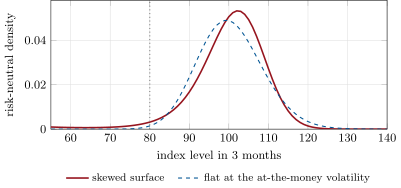
Risk-neutral densities of the index in three months from Breeden–Litzenberger applied to call prices: with the chapter’s skew (solid) and with a flat surface at the same at-the-money volatility (dashed). The skew moves probability into the left tail and makes the density’s peak sit above the forward; the probability below 80 (dotted) rises from 0.31% to 1.89%. Data: the tutorial.
Figure 7.4. Risk-neutral densities of the index in three months from Breeden–Litzenberger applied to call prices: with the chapter’s skew (solid) and with a flat surface at the same at-the-money volatility (dashed). The skew moves probability into the left tail and makes the density’s peak sit above the forward; the probability below 80 (dotted) rises from 0.31% to 1.89%. Data: the tutorial.

Examples

Example 7.7 (The crash premium)

On the chapter’s surface the three-month forward is 100.37 and the at-the-money volatility 16.36%. With a flat surface at that level the risk-neutral probability that the index ends below 80 is 0.31%; with the skew, whose 80 strike is at 26.8 volatility, it is 1.89%, six times more (Figure 7.4). The 80 put costs 0.006 on the flat surface and 0.219 on the skewed one.

Read in context →