सभी किताबें

पेशेवर

ऐप्स परिचय Coach लॉग इन पढ़ना शुरू करें

Quantitative Finance · शब्दावली

Rough volatility क्या है?

Definition 12.5 Derivatives and Volatility · अध्याय 12 — Rough Volatility and Forward-Variance Models

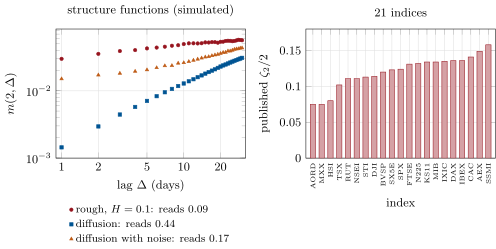
Rough volatility is the property, and the class of models built on it, that the logarithm of instantaneous volatility behaves at short time scales like a fractional Brownian motion with Hurst exponent H<12H<\frac12, typically near 0.1. Its paths are rougher than any diffusion’s: the typical move over a lag Δ\Delta scales like ΔH\Delta^H rather than Δ1/2\Delta^{1/2}.

Left: the structure function of simulated daily log-volatility over eight years. The slope on log-log axes is 2H. The rough path has H=0.1; the diffusion is an Ornstein–Uhlenbeck process; the third series is the diffusion seen through a realised-variance estimate with a 0.08 error in log. Right: the published estimates for 21 indices. Data: the chapter’s code; Gatheral, Jaisson and Rosenbaum (2014), table B.1.
Figure 12.3. Left: the structure function of simulated daily log-volatility over eight years. The slope on log-log axes is 2H2H. The rough path has H=0.1H=0.1; the diffusion is an Ornstein–Uhlenbeck process; the third series is the diffusion seen through a realised-variance estimate with a 0.08 error in log. Right: the published estimates for 21 indices. Data: the chapter’s code; Gatheral, Jaisson and Rosenbaum (2014), table B.1.
अध्याय में पढ़ें →